



Discussion Questions
Answers from different perspectives for reference
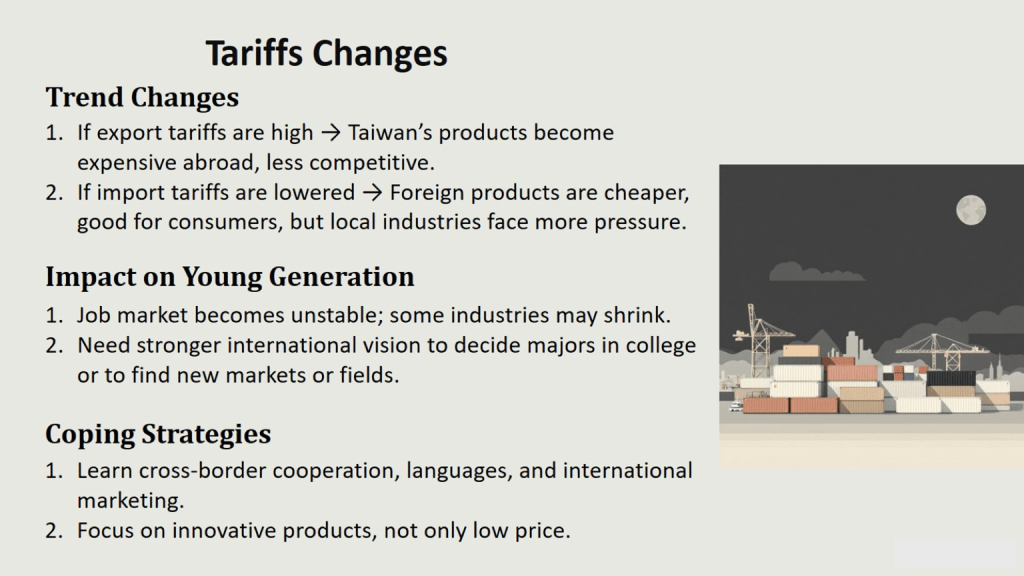
Tariffs (關稅)
Q1. If Taiwan’s exports face higher tariffs and become more expensive abroad, which industries or jobs do you think will be most affected?
Perspective: Optimistic Innovator
Even if tariffs rise, I think Taiwan can adapt by focusing on innovation instead of price. For example, chips from TSMC are so advanced that buyers may still need them, no matter the cost. Tariffs might push local companies to upgrade technology faster and create niche products that other countries cannot easily replace. Of course, some industries like agriculture may suffer, but this challenge could encourage farmers to build strong brands or find new regional markets. For me, I see tariffs as tough but also a chance for creativity.
Q2. Would you prefer to work for a company that serves mainly the local market, or one that relies on exports? Why?ompanies…
Perspective: Practical Risk Manager
If I think about my own career, I would probably choose a company that mainly serves the local market. Export companies face too many risks: tariffs, currency changes, and global politics. Local-focused companies, like those in healthcare, food, or services, are more stable because people always need them. Of course, the salary may be smaller compared to international companies, but stability is more important for me. If I can build my skills in a safe environment, maybe later I can consider working in an international firm.
Currency Value (幣值)
Q3. If the Taiwan dollar becomes stronger, what changes would you notice in your daily life (shopping, studying abroad, or traveling)?
Perspective: Young Traveler
If the Taiwan dollar becomes stronger, the first thing I would notice is traveling. Suddenly, flights, hotels, and even shopping abroad become cheaper. Studying overseas would also be easier, because tuition and rent cost less when converted into NTD. I think my daily life in Taiwan may not change much, but my opportunities to go abroad would definitely improve. For me, a stronger currency means more freedom to see the world and learn new things outside of Taiwan. That is very exciting for young people like me.
Q4.Do you think it is important for young Taiwanese to understand currency changes? How could this knowledge help in real life?
Perspective: Skeptical Youth
Honestly, I don’t think every young person needs to learn about currency. Most of us will not trade stocks or work in finance. As long as our salaries are stable and we can pay for daily expenses, exchange rates don’t matter much. If I travel abroad, I can just use an app to check the best time to exchange money. For me, understanding currency feels too technical and far away from my daily life. Instead of studying exchange rates, I’d rather focus on improving my work skills.
Domestic Issues (國內議題:政治與司法)
Q5. Do you think Taiwan is politically stable today? How might political stability (or instability) affect your future career?
Perspective: Critical Observer
I don’t think Taiwan is very politically stable. There are too many conflicts between parties, and sometimes the government spends more time fighting than solving problems. For young people, this makes the job market uncertain, because investors may not trust a country with constant political drama. Even if the economy is strong, instability in politics can ruin opportunities. For me, political stability is very important. If I feel the system is chaotic, I may even consider working abroad. I want to focus on my career, not on endless political news.
Q6. Can you think of a system in Taiwan that feels unfair? How do you think it affects society and young people?
Perspective: Socially Concerned Student
I think the education system in Taiwan is unfair. There is too much pressure on exams, and many students from poor families cannot afford expensive tutoring. This creates a big gap between rich and poor. For young people, it feels like your future depends not only on effort but also on family background. Some talented students give up because they feel the system is not fair. In the long run, this affects society because we lose potential talent and creativity. I think education should give more equal opportunities to everyone.
Economic Trends (經濟發展趨勢:AI、半導體等)
Q7. Are you worried that AI might replace your future job? Why or why not?
Perspective: Tech Optimist
I am not really worried about AI. Yes, it may take away some repetitive jobs, but it also creates new industries that never existed before. For example, who thought about AI ethics or AI trainers ten years ago? Also, AI can reduce boring tasks, so people can focus on creative or strategic work. For me, AI is like electricity in the past—it changes everything, but it also makes life better. If I keep learning, I can use AI as a tool to grow my career, not as a competitor.
Q8. Why do you think TSMC is building factories in the US? What challenges or concerns might it face there?
Perspective: Strategic Thinker
I think TSMC is building factories in the US mainly because of politics, not business. The US wants to reduce dependence on Taiwan, in case of conflict with China. But TSMC faces challenges: higher costs, fewer skilled engineers, and slower efficiency. For Taiwan, the concern is bigger—if too much technology moves abroad, Taiwan may lose its “silicon shield.” As a young person, this worries me, because Taiwan’s economy depends heavily on semiconductors. I hope TSMC can balance between keeping its most advanced technologies in Taiwan and satisfying US demands.
知識英語工作坊報告寫作架構
自訂標題:How Global Trends Shape My Daughters’ Future
1. 介紹 Introduction (around 50 words)
- 開頭語例子:The world is changing quickly, and Taiwan is deeply connected to these changes.
- 提示作者視角:Mention being a 64-year-old father with two daughters.
- 主題論述 (Thesis Statement):I think less about my own career and more about how these changes will shape their future opportunities.
2. 主體(1) Economic/Trade Trend (80–90 words)
- 重點:Tariffs and currency changes.
- 說明:Higher tariffs or a stronger Taiwan dollar make exports less competitive, reducing job opportunities in electronics, machinery, and agriculture.
- 連結主題論述:For my daughters, this means traditional career paths may not be reliable.
- 舉例或證明:They need flexibility and awareness of global trade and currency issues.
3. 主體(2) Technology Trend (around 100 words)
- 重點:AI and semiconductors.
- 說明:Taiwan’s strength in chips faces global competition and political pressures; AI is transforming jobs.
- 連結主題論述:Some jobs may disappear, but new ones will appear if they combine human skills with digital tools.
- 舉例或證明:my daughters should learn digital skills, improve English, and develop creativity, empathy, and cross-cultural communication.
4. Conclusion (around 100 words)
- 回到我的論述:Global trends are powerful forces that directly shape young people’s futures.
- 宏觀結束:For my daughters, these trends are both challenges and opportunities. With preparation, they can build meaningful and resilient careers.
範本:How Global Trends Shape My Daughters’ Future
- (起頭帶讀者進入文境中)The world is changing quickly, and Taiwan is deeply connected to these changes. From tariffs and currency values to the rise of artificial intelligence, global trends affect not only industries but also the personal careers of young people. (主題論述帶讀者進入二三段主體) As a 64-year-old father with two daughters, aged 19 and 22, I think less about my own career and more about how these changes will shape their future opportunities.
- 主體(1) One important factor is trade and the economy. If Taiwan’s exports face higher tariffs or if the Taiwan dollar becomes too strong, our products may become less competitive in global markets. This could reduce job opportunities in key industries like electronics, machinery, and agriculture. For my daughters, this means they cannot simply rely on traditional career paths. They will need to be flexible, perhaps focusing on jobs connected to the local market or roles that require international cooperation. Understanding trade and currency issues will help them make better career choices.
- 主體(2) Another powerful trend is technology, especially AI and semiconductors. Taiwan is a global leader in chips, but the competition is intense, and the industry faces geopolitical pressures. At the same time, AI is transforming almost every field. While some jobs may disappear, new opportunities will appear for people who can combine human skills with digital tools. For my daughters, this means learning digital skills, improving their English, and developing abilities that AI cannot easily replace, such as creativity, empathy, and cross-cultural communication.
- 結論 In conclusion, global trends are not just distant headlines; they are powerful forces that will directly shape the lives of young Taiwanese people. For my daughters, these trends are both challenges and opportunities. If they prepare early, they will be able to build meaningful and resilient careers in a fast-changing world.










 超凡遠距知識英語