中級CI聽/說雙重訓練

中級1CI(逐步口譯)訓練:這是專為超凡遠距中級學員建立的CI訓練頁面。
無論您是(1)注重口說寫作的國高中生; (2)提升競爭力的英文老師; (3)努力成為各科雙語老師; 或(4)提升專業英語說寫能力的碩博生或社會人士。請洽客製化訓練課程詢問專線

中級 1

Unit 1 Puppy Love

Unit 2 Surprise! It is your wedding!

Unit 3 Bad News, Good News!

Unit 4 The Twins of Siam

Unit 5 The Baby Exchange

Unit 6 The Ghost

Unit 7 Everybody’s Baby

Unit 8 Pay It Forwards

Unit 9 Margret Patrick meets Lucy Eisenberg.

Unit 10 Finders Keepers

Unit 11 The Husband

Unit 12 The Auction

中級 2

Unit 1 Money to Burn

Unit 2 Two Strangers

Unit 3 A Long Fishing Trip

Unit 4 The Surgeon

Unit 5 Customer Service

Unit 6 The Mermaid Balloon

Unit 7 The Two Lives of Mary Sultan

Unit 8 The School and The Stamp

詞性是文法句型的要素

英文文法就是將單字以正確詞性,擺放在句子中正確的位置。這一單元簡潔說明如何對英文的詞類做出正確判斷或辨識,列出真正附加在單字後方的字尾(suffix)所形成的詞類變化。雖然是通則,不能涵蓋每一個英文單字,但足以幫助學習者正確應用大量的單字。

形成名詞常用的附加字尾

  1. er或-or: 用來加在動詞後面表示 執行這個動詞的動作的人或物,通常是-er但是有些是-or,兩者的轉換沒有規則可循。例如:
    worker, runner, consumer, pencil sharpener, bottle opener, projector.
  2. ee: 用來跟-er做對比,-er如前所說明,是執行動作的人或物,-ee則是接收或體驗這個過程的人。例如:
    employer/employee, trainer/trainee, payer/payee, interviewer/interviewee.
  3. tion/-sion/-ion: 這些字尾用以將動詞變成名詞。例如:
    pollute/pollution, reduce/reduction, act/action.
  4. ism: 用來表示一種行動、意識形態、專業或信仰。例如:
    liberalism, Buddhism, socialism, journalism, terrorism.
  5. ist: 用來表示有某種意識形態、專業或信仰的人。例如:
    liberalist, Buddhist, socialist, journalist, terrorist.
  6. ness: 這些字尾用以將形容詞變成名詞,尤其是以-y結尾的形容詞。例如:
    happiness, laziness, goodness, forgetfulness, sadness.
  7. ment: 這些字尾用以將動詞變成名詞。例如:
    excitement, enjoyment.
  8. ity: 如果形容詞字尾以-able或-ible結尾(參考下方形成形容詞常用的附加字尾),通常適用這變化,但是並非所有-ity結尾名詞均來自-ble結尾的形容詞。例如:
    flexibility, productivity, activity, ability.
  9. hood: 通常指成長的階段,例如:
    childhood, motherhood, adulthood.
  10. ship: 通常指某種狀態,例如:
    friendship, partnership, membership.
  11. al: 這些字尾用以將動詞變成名詞,表達該動作本身。例如:
    refusal, arrival, approval

形成形容詞常用的附加字尾

  1. able或-ible:用來附加在動詞字尾而形成「…能夠…」的含意,例如drinkable含有can be drunk的涵義。例如:
    washable, breakable, eatable, edible, controllable.
  2. ive: 加在動詞後構成形容詞,表達「有…作用的,有…性質的」,例如:
    passive, productive, active.
  3. al: 用作形容詞的後綴,表達「與…有關的」,例如:
    legal, brutal.
  4. ous: 通常加在名詞後以構成形容詞的後綴,表示一種性質或條件,例如:
    dangerous, ambitious, delicious, furious, various.
  5. ful: 通常加在名詞後以構成形容詞的後綴,表示該名詞的高質量,例如:
    forgetful, hopeful, useful, powerful, mouthful, handful
  6. less: 通常加在名詞後構成形容詞,表示該名詞的低質量或卻乏名詞的特質,例如:
    useless, harmless, homeless, friendless, meaningless.

形成動詞常用的附加字尾

  1. ize: 通常加在形容詞後方表達形容詞的形成過程,例如standardize標準化,是形成標準的過程。其他例子:
    modernize, commercialize, popularize, industrialize, computerize.
    *附加說明:這一類的字通常以-ization的字尾變化變成名詞。例如:
    modernization現代化。
  2. ify: 通常加在名詞或形容詞後方表達該名詞或形容詞的形成過程,例如:
    beautify, purify, terrify.

練習 1閱讀題目並試著用-er或-or, -ee或-ist拼出下列名稱或頭銜的名詞:

例如: A person who plays jazz on the piano is a _______________.
答案: jazz pianist

  1. A person who plays classical piano is a _______________.
  2. The thing that wipes rain off your car windshield is a _______________.
  3. A person who takes professional photographs is a _______________.
  4. A person who is employed by someone else is a _______________.
  5. An appliance for drying hair is a _______________.
  6. A person who donates his/her organs upon death is a _______________.
  7. A small device that you can use in your hand to hold pieces of paper together is a _______________.
  8. A small device that helps people to do calculations is a _______________.

練習 2:利用拼字變化改變詞類,將畫底線的字以另外一種詞類表現相同的含意。

  1. Most of his crimes can be forgiven.
    > Most of his crimes are ________________.
  2. The club refuses to admit anyone not wearing shoes.
    > The club refuses ________________ to anyone not wearing shoes.
  3. Her only fault is that she is lazy.
    > Her only fault is ________________.
  4. This company has produced a lot in recent years.
    > This company has been very ________________ in recent years.

練習 3:如果你已經建立好了詞類變化的觀念,能否運用這些觀念回答下列問題呢?
這些問題沒有標準答案,純粹是個人想法。
  1. What should be privatized in Taiwan?
  2. What should be standardized in Taiwan?
  3. What should be modernized in Taiwan?
  4. What should be computerized in Taiwan?
  5. What is often politicized in Taiwan?

ask, request, require, demand都一樣嗎!

這四個動詞都有「要求、請求、需要」的意義,但內涵及用法並不相同。

  • ask最常見,初學者用ask表達「問問題」,例如May I ask a question? 所以ask是為了完成某事而口頭(或書面)提出請求,甚至有「拜託」的意思,例如:
    (1) I asked for help. (我請求協助)
    (2) I asked my classmates to help me. (我請求我的同學幫我)
    (3) Father asked that we stay at home at night. (爸爸要求我們晚上待在家。)

  • request通常是有權提出的(正式)請求,當有人對我們說It is my request. 代表那個人對我們提出有道理的要求。例句:
    (1) The villagers requested assistance. (那些村民請求幫助)
    (2) We requested the local government to return our land. (我們要求政府歸還土地)
    (3) They requested that the meeting be held next Friday. (他們要求會議下周五舉辦)

如果將句子改成They asked that the meeting beheld next Friday.意思上有請求或拜託的意思。

  • require是指根據法律、規定提出要求,意為「依照規定…」,常用在被動語氣。例句:
    (1) Students require more help in the first term. (學生在第一學期需要較多協助)
    (2) We had better do things that are required by law. (我們最好已依法完成一切)
    (3) The rules require that you bring one guest to the meeting. (按照規定,你要帶一位來賓出席會議)

  • demand是「(強烈)要求」的意思,所以常用We have a demanding teacher.來描述要求很多的老師。例句:
    (1) I demand my rights. (我要求應有權利)
    (2) The police demanded our name and address. (警方要求我們提供姓名住址)。
    (3) The library demanded that he return the books he borrowed in a week. (她要求他把從她那裡借走的書還回來。)

這四個動詞的受詞都可用that +名詞子句表達「急迫性語氣」,只是強度不同。

  1. The students asked that they (should) be allowed to use a calculator. (學生要求被允許用計算機)。句中的should可以省略,但動詞仍是原形be allowed。
  2. Teachers requested that the government halt the plan. (老師要求政府停止該計畫)
  3. The manager required that the machines work all night. (廠長要求機器整晚運作)
  4. The boss demanded that we finish the work in 2 days. (老板要求我們兩天內完成)

無論您是(1)注重口說寫作的國高中生; (2)提升競爭力的英文老師; (3)努力成為各科雙語老師; 或(4)提升專業英語說寫能力的碩博生或社會人士。請洽客製化訓練課程詢問專線

唯一雲端虛擬教室,將想法全文輸入輸出訓練🎯,雲端專人訂正提供改善建議。
影片線上教學平台:Youtube教學頻道
提升國際競爭力 加入超凡遠距 

Where will be the place of our children in the future?

學習單字

  1. outstrip (程度或成就上)超過
  2. clock需時;達到一個時間
  3. intervention 干涉
  4. impressive令人印象深刻的
  5. autonomous 自動化的
  6. champion冠軍
  7. identify辨識
  8. reflect反省
  9. exaggerate誇張說法

In one or two decades, AI will outstrip many of the abilities we humans believe make us different from animals and machines.

In 2016, Google’s self-driving cars clocked 1,023,330km, and required human intervention 124 times. That is one human intervention about every 8,047km of autonomous driving. What makes the figure impressive is, in 2015, it was 4 interventions every 8,047km. In order words, autonomous driving had made a 400% improvement.

Today, self-driving cars may not be a norm. It is already a reality. You probably think “how nice!” We can take a nap on our way to office because AI can drive for us. But what about playing chess! A computer has beat the human chess champion a few times. And the computer is now identifying tumor for doctors and cooking recipes for chefs. AI is even helping our kids learn English😣.

I wonder what my daughters will be doing in the future. They will never solve a math question faster or lift an object heavier than AI does. They will never drive better. They are human, so they can never become the best chess player. And language, the best thing I pass down to them through telling them many good stories, is no more their advantage since real-time machine translation has made huge improvement. They are likely to lose every battle against AI, aren’t they?

No! What exactly makes humans special? We dream, imagine, reflect, and even regret! We pretend, invent, exaggerate, and go crazy. That’s right! We are different from AI because we create.

烏俄(惡)之戰不是烏克蘭的戰爭

學習單字

  1. invasion侵略
  2. military軍事的
  3. aggressive好戰的
  4. amass聚集
  5. diplomatic外交
  6. sanction經濟制裁
  7. overwhelming全面的
  8. indiscriminate無差別的
  9. prompt造成
  10. collapse瓦解
  11. justify合理化
  12. solemn神聖
  13. pledge承諾

The Root Cause of the Ukraine War
俄羅斯與烏克蘭戰爭的根源

Russia’s invasion of Ukraine is the biggest military mobilization in Europe since World War II.
俄國對烏克蘭的侵略是第二次世界大戰之後歐洲最大的軍事的動員,
It seems that an aggressive Russian leader amassed troops and invaded its neighbor.
看起來似乎是一個好戰的國家領導人聚集軍隊,然後侵略鄰國。
Then several rounds of diplomatic talks between Russia and Ukraine have failed to stop the war, so some countries led by the US stood together to impose sanctions on Russia over the invasion.
接著就是俄羅斯跟烏克蘭之間進行幾輪失敗的外交談判,美國為主導的西方國家開始站在一起,對俄羅斯的侵略行為實施經濟制裁
Taiwan is one of those countries.
台灣也加入這個制裁的行列。

However, Russia didn’t stop there.
然而俄羅斯並沒有因此而停止,
It has been increasingly intensifying attacks, flattening cities with overwhelming and indiscriminate firepower.
反而不斷的加強攻擊,對城市進行全面的無差別的砲火襲擊。
The war has claimed thousands of lives.
這場戰爭已經造成了數千人死亡,
It has also prompted more than two million people to flee Ukraine in less than two weeks, spurring refugee crisis.
戰火造成超過2百萬人兩周內逃離烏克蘭,造成難民危機。

While most people focus on the invasion, fatalities, and refugees, few focus on the cause.
相對於大多數人將焦點放在侵略、死傷、及難民,很少人去注意到這場戰爭的起因。

After the Soviet Union collapsed in the early 1990s, NATO expanded eastward, eventually taking in most of the European nations that had once been in the Soviet Union.
在1990年代初期蘇聯瓦解後,北大西洋公約組織往東擴展,最終將歐洲大多數原屬於蘇聯的國家的納入北約。
For example, the Baltic republics of Lithuania, Latvia and Estonia joined NATO in 2004.
例如,波羅的海的立陶宛、拉脫維亞、愛沙尼亞共和國都在2004年加入了北約。
As a result, NATO moved hundreds of miles closer to Moscow, directly bordering Russia.
結果就是北大西洋公約組織擴張到距離莫斯科只剩下700英里,已經直接跟俄國交接了。
And in 2008, NATO stated that it planned to enroll Ukraine.
而2008年北約公開宣稱要將烏克蘭納入北約。

Russia claims that the West broke a promise it made in the 1990s not to expand NATO and is using this claim to justify its invading Ukraine.
俄羅斯宣稱西方國家沒有遵守1990年代的承諾:北約不向東擴展,俄羅斯也因此將侵略烏克蘭合理化
In a speech at the Munich Security Conference in 2007, Putin accused Western powers of violating a solemn pledge by enlarging NATO. 
2007年普丁在慕尼黑安全會議的一場演說中說:西方各國違反了不擴張北約的這項神聖承諾。

However, NATO has not stopped expanding since the fall of the Soviet Union, growing from 17 countries in 1990 to 30 today, several of which were once part of the Soviet-led Warsaw pact.
然而蘇聯解體之後,北約從未停止繼續向東擴張,從1990年代的17個成員國,擴張到今天的30個成員國,這些北約成員國中好幾個是屬於過去蘇聯時代的華沙公約成員國,
As a result, Russia claims that it is protecting itself.
因此俄國宣稱目前只是在進行自我保護。

Ukraine is indeed suffering between two superpowers that are pushing against each other.
烏克蘭的確在兩大強權互相較勁的夾縫中遭受極大苦難,
Hopefully, Taiwan doesn’t have to in a similar situation.
希望台灣不需要處於相同的困境。

加入超凡遠距進行全文輸入輸出訓練,立即提升國際語競爭力。

Unit 29   Shopping Behavior

  1. Over the years, there have been changes in people’s buying behavior. What is a big change that you have noticed? Explain with examples.
    過去多年來,人們的購買行為有許多改變,其中你有注意到的最大改變是什麼?請舉例說明。
  2. What are the causes that may make people change their buying behavior? Explain with examples.
    造成人們改變購買行為改變的原因是什麼?請舉例說明。
  3. What are the advantages or disadvantages when we go shopping at traditional markets, supermarkets or hypermarkets?
    在下列這些地方買東西的好處跟壞處是甚麼:傳統市場、一般超市、大型超市?
  4. Do you prefer shopping at traditional markets, supermarkets or hypermarkets? Why or why not?
    你比較喜歡在傳統市場、一般超市、或大型超市購物?為什麼(不)?
  5. What are some advantages and disadvantages when you buy things at convenience stores or supermarkets?
    在便利超商或一般超商買東西的一些好處跟壞處是甚麼?
  6. What are the advantages or disadvantages of physical markets and virtual markets?
    實體市場及虛擬市場的好處跟壞處是甚麼?
  7. Do you think traditional markets will soon disappear? Explain?
    你認為傳統市場即將消失嗎?請解釋原因。
  8. Do you agree that women are better at shopping and bargaining than men? Why?
    你贊成女人比男人比較會買東西,也比較會討價還價的說法嗎?
  9. Do you think advertisements affect people’s buying behavior? How?
    你認為廣告會影響人們的購物行為嗎?
  10. Do you think coupons or discounts really work? Do they help consumers save money? Why or why not?
    你認為折價券或者折扣真的能效果嗎?能夠幫助消費者省錢嗎?為什麼(不)?
  11. Why are people crazy about name-brand products that they would rather spend more money or even pay for them in installments?
    為什麼人們對於名牌的商品瘋狂到甚至願意花較多錢或分期付款來購買?

Vocabulary List

  1. physical market實體商店
  2. virtual market虛擬商店
  3. bargain討價還價
  4. coupon折價卷
  5. namebrand名牌
  6. installment分期付款

無論您是(1)注重口說寫作的國高中生; (2)提升競爭力的英文老師; (3)努力成為各科雙語老師; 或(4)提升專業英語說寫能力的碩博生或社會人士。請洽客製化訓練課程詢問專線

唯一雲端虛擬教室,將想法全文輸入輸出訓練🎯,雲端專人訂正提供改善建議。
影片線上教學平台:Youtube教學頻道
提升國際競爭力 加入超凡遠距 

Unit 21 Reflection and Expectation

回顧與展望

  1. What is the best thing that happened to you over the last year and how does it affect your future?
    在過去一年發生在你身上最棒的事情是甚麼?這件事情如何影響你的未來?
  2. What is the worst thing that happened to you over the last year and how does it affect your future?
    在過去一年發生在你身上最糟的事情是甚麼?這件事情如何影響你的未來?
  3. What are you most looking forward to in the new year and how will it affect you?
    在新的一年你最期待的是甚麼事情?這件事情如何影響你?
  4. What are your two short-term goals, one long-term goal? How do you reach your goal?
    你的兩個短期目標是甚麼?一個長期目標是甚麼?你如何抵達你的目標?

無論您是(1)注重口說寫作的國高中生; (2)提升競爭力的英文老師; (3)努力成為各科雙語老師; 或(4)提升專業英語說寫能力的碩博生或社會人士。請洽客製化訓練課程詢問專線

唯一雲端虛擬教室,將想法全文輸入輸出訓練🎯,雲端專人訂正提供改善建議。
影片線上教學平台:Youtube教學頻道
提升國際競爭力 加入超凡遠距 

Unit 18 Worry, Fear, and Phobia

  1. What are the differences among worry, fear, and phobia?
    Try to define and explain each with your own examples.
    試著分辨 worry、fear、phobia 三者的差異,並舉例說明。
  2. What are two things you often worry about?
    Why do they bother you, and what can you do to overcome them?
    你常擔憂的兩件事是什麼?為何?你要如何排除這些擔憂?
  3. What are you afraid of in life—such as losing a job, getting poor grades, or entering a bad school? What might help you deal with this fear?
    你害怕哪些事?例如失業、爛成績、進爛學校等。該如何面對這些恐懼?
  4. Do you have any phobia? How do you usually react when facing it, and what causes it?
    你有恐懼症嗎?遇到時會如何反應?又是什麼引起的?
  5. Do you know anyone with a phobia? How do they react, and what do you think of their situation?
    你認識有恐懼症的人嗎?他們的反應如何?你對此有何看法?
  6. Among the following, which are you most afraid of: flying, public speaking, heights, darkness, being alone, or something else? Why?
    以下哪一項最令你害怕?飛行、演說、高度、黑暗、孤單或其他?為何?
  7. Why do people fear things they’ve never seen—like ghosts or aliens?
    Do you believe such fears are a kind of phobia?
    為何人們會害怕從未見過的事物,如鬼或外星人?這算是恐懼症嗎?
  8. Fear is only in your mind. Do you agree or disagree?
    Explain your opinion and give an example.
    你是否認同「恐懼只存在心中」?請說明理由並舉例。
  9. Have you ever been “once bitten, twice shy”?
    Describe your experience and how it changed your behavior.
    你是否有過「一朝被蛇咬,十年怕井繩」的經驗?發生了什麼事?
  10. Do you think it’s possible to live a life without worry or fear? Why or why not?
    你認為有可能過著無憂無懼的生活嗎?為什麼?

參考單字

  1. fear恐懼: 當你害怕某種可怕的事情可能發生時的感受。
  2. phobia恐懼症: 一種對某事不理性恐懼,這種恐懼可能不存在於多數人心中。
    常見的phobia: 對動物,對自然環境,對血液,對特定情境 (獨自搭電梯)。

無論您是(1)注重口說寫作的國高中生; (2)提升競爭力的英文老師; (3)努力成為各科雙語老師; 或(4)提升專業英語說寫能力的碩博生或社會人士。請洽客製化訓練課程詢問專線

唯一雲端虛擬教室,將想法全文輸入輸出訓練🎯,雲端專人訂正提供改善建議。
影片線上教學平台:Youtube教學頻道
提升國際競爭力 加入超凡遠距 

國一Alyssa演講稿的形成

許多年輕學員進行英語演講訓練時常常會說不知道要講甚麼,這時我們的引導方式就是
(1) 跟學員聊聊天,了解學員生活中有哪些事情是具有意義且難忘的。
(2) 接著我們請學員先用中文完成演講的初稿。如下圖左邊。
(3) 將學員的中文初稿修正成容易以英文結構輸出的版本。如下圖右邊。
(4) 由學員將修正後的版本翻譯成英文。如下方英文稿。
(5) 英語教練修正英文稿後,再跟學員討論出最後的演講版本。

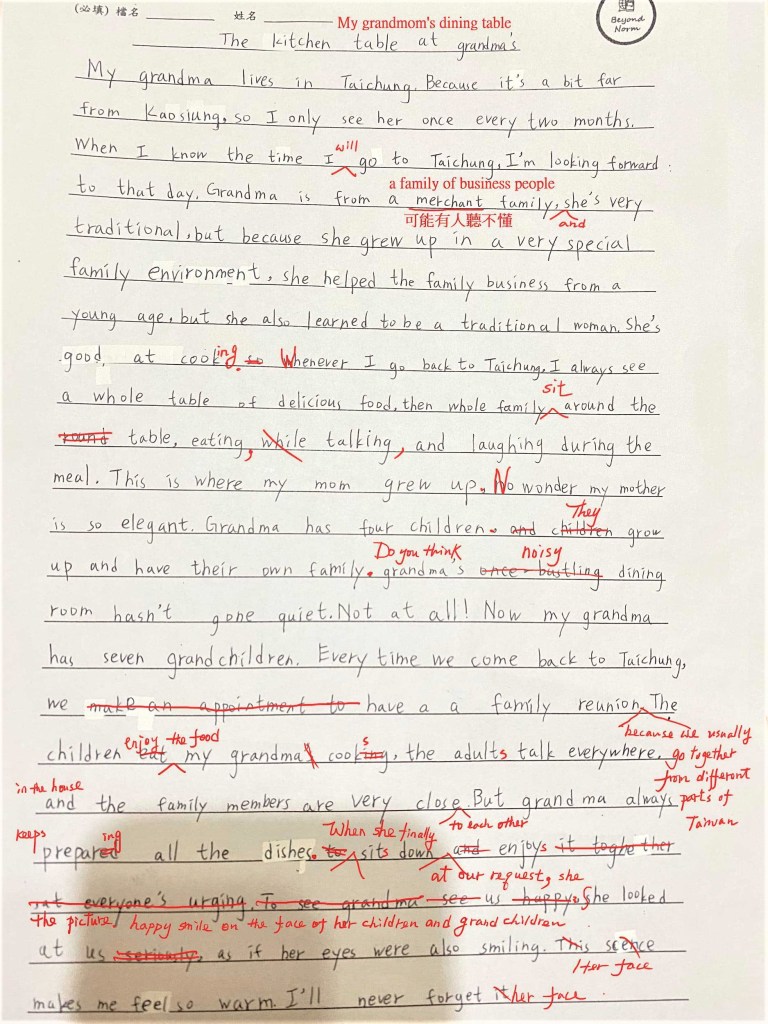
第四步驟:國一學員完成的英文稿

最後演說版本

My Grandma’s Dining Table

  1. My grandma lives in Taichung. Because it is a bit far from Kaohsiung, I only see her once every two months. When I know the time I will go to Taichung, I am looking forward to that day.
  2. Grandma is from a family of business people, but she is still very traditional. Because she grew up in the very special family environment, she helped her family do business from a young age, but she also loves to be a traditional woman. She is good at cooking. Whenever I go back to Taichung, I always see a table full of delicious food. Then the whole family sit around the table, eating, talking, and laughing during the meal. This is where my mom grew up. No wonder my mother is so elegant.
  3. Grandma has four children. They grew up and have their own children. Do you think Grandma’s noisy dining room has gone quiet? No, not at all! Now my grandma has seven grandchildren. Every time we come back to Taichung we have family reunions because we usually go back together from different parts of Taiwan. The children enjoy the foot my grandma cooks. The adults talk everywhere in the house. All the family members are very close to each other.
  4. Whenever we all get together, grandma always keeps preparing all the dishes. When she finally sits down at our request, she is happy when everyone is happy. She looks at the happy smile on the face of her children and grandchildren, her eyes look like smiling. Her face makes me feel warm. I will never forget my grandma’s dining table.

高效英語提升(龍騰)

高效率英語訓練旨在幫助學習者快速閱讀、消化、內化,最後輸出分享,高效率訓練重視學習成效、不注重娛樂效果。加入超凡遠距全文輸入輸出訓練進行高效率全文說寫訓練。

中學階段英語能力快速成長關鍵在於背景知識擴充,傳統英語課程用很長的時間補充單字、解釋文法,但是對於課文本身的價值觀及重要資訊往往忽略,如此學習者無法擴充背景知識。

龍騰第一冊