Global Trends, Local Careers, From Tariffs to Technology!

本主題的寫作報告架構及寫作範本

Discussion Questions
Answers from different perspectives for reference

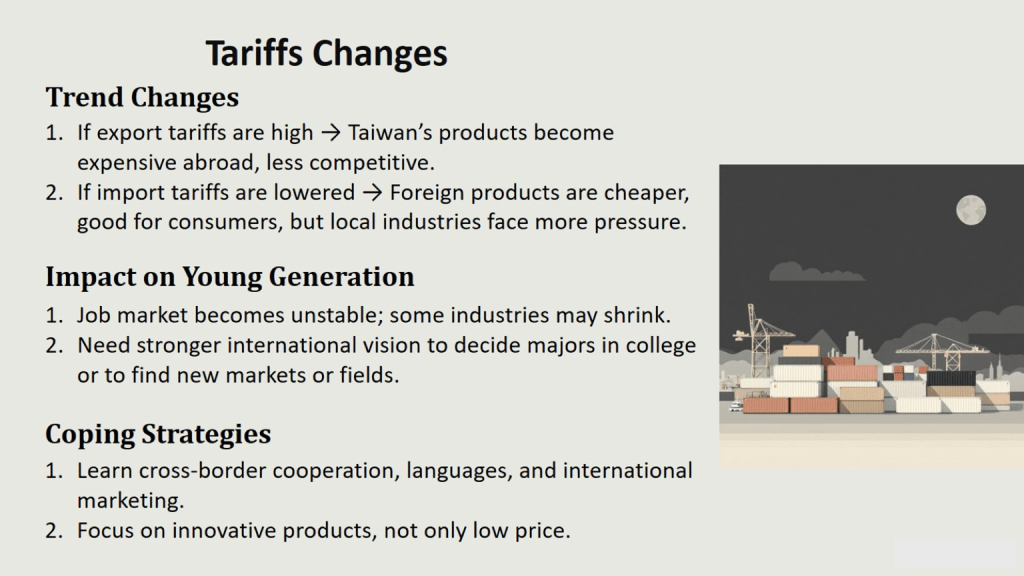
Tariffs (關稅)

Q1. If Taiwan’s exports face higher tariffs and become more expensive abroad, which industries or jobs do you think will be most affected?
Perspective: Optimistic Innovator
Even if tariffs rise, I think Taiwan can adapt by focusing on innovation instead of price. For example, chips from TSMC are so advanced that buyers may still need them, no matter the cost. Tariffs might push local companies to upgrade technology faster and create niche products that other countries cannot easily replace. Of course, some industries like agriculture may suffer, but this challenge could encourage farmers to build strong brands or find new regional markets. For me, I see tariffs as tough but also a chance for creativity.

Q2. Would you prefer to work for a company that serves mainly the local market, or one that relies on exports? Why?ompanies…
Perspective: Practical Risk Manager
If I think about my own career, I would probably choose a company that mainly serves the local market. Export companies face too many risks: tariffs, currency changes, and global politics. Local-focused companies, like those in healthcare, food, or services, are more stable because people always need them. Of course, the salary may be smaller compared to international companies, but stability is more important for me. If I can build my skills in a safe environment, maybe later I can consider working in an international firm.

Currency Value (幣值)

Q3. If the Taiwan dollar becomes stronger, what changes would you notice in your daily life (shopping, studying abroad, or traveling)?
Perspective: Young Traveler
If the Taiwan dollar becomes stronger, the first thing I would notice is traveling. Suddenly, flights, hotels, and even shopping abroad become cheaper. Studying overseas would also be easier, because tuition and rent cost less when converted into NTD. I think my daily life in Taiwan may not change much, but my opportunities to go abroad would definitely improve. For me, a stronger currency means more freedom to see the world and learn new things outside of Taiwan. That is very exciting for young people like me.

Q4.Do you think it is important for young Taiwanese to understand currency changes? How could this knowledge help in real life?
Perspective: Skeptical Youth
Honestly, I don’t think every young person needs to learn about currency. Most of us will not trade stocks or work in finance. As long as our salaries are stable and we can pay for daily expenses, exchange rates don’t matter much. If I travel abroad, I can just use an app to check the best time to exchange money. For me, understanding currency feels too technical and far away from my daily life. Instead of studying exchange rates, I’d rather focus on improving my work skills.

Domestic Issues (國內議題:政治與司法)

Q5. Do you think Taiwan is politically stable today? How might political stability (or instability) affect your future career?
Perspective: Critical Observer
I don’t think Taiwan is very politically stable. There are too many conflicts between parties, and sometimes the government spends more time fighting than solving problems. For young people, this makes the job market uncertain, because investors may not trust a country with constant political drama. Even if the economy is strong, instability in politics can ruin opportunities. For me, political stability is very important. If I feel the system is chaotic, I may even consider working abroad. I want to focus on my career, not on endless political news.

Q6. Can you think of a system in Taiwan that feels unfair? How do you think it affects society and young people?
Perspective: Socially Concerned Student
I think the education system in Taiwan is unfair. There is too much pressure on exams, and many students from poor families cannot afford expensive tutoring. This creates a big gap between rich and poor. For young people, it feels like your future depends not only on effort but also on family background. Some talented students give up because they feel the system is not fair. In the long run, this affects society because we lose potential talent and creativity. I think education should give more equal opportunities to everyone.

Economic Trends (經濟發展趨勢:AI、半導體等)

Q7. Are you worried that AI might replace your future job? Why or why not?
Perspective: Tech Optimist
I am not really worried about AI. Yes, it may take away some repetitive jobs, but it also creates new industries that never existed before. For example, who thought about AI ethics or AI trainers ten years ago? Also, AI can reduce boring tasks, so people can focus on creative or strategic work. For me, AI is like electricity in the past—it changes everything, but it also makes life better. If I keep learning, I can use AI as a tool to grow my career, not as a competitor.

Q8. Why do you think TSMC is building factories in the US? What challenges or concerns might it face there?
Perspective: Strategic Thinker
I think TSMC is building factories in the US mainly because of politics, not business. The US wants to reduce dependence on Taiwan, in case of conflict with China. But TSMC faces challenges: higher costs, fewer skilled engineers, and slower efficiency. For Taiwan, the concern is bigger—if too much technology moves abroad, Taiwan may lose its “silicon shield.” As a young person, this worries me, because Taiwan’s economy depends heavily on semiconductors. I hope TSMC can balance between keeping its most advanced technologies in Taiwan and satisfying US demands.

知識英語工作坊報告寫作架構

自訂標題:How Global Trends Shape My Daughters’ Future

1. 介紹 Introduction (around 50 words)

  • 開頭語例子:The world is changing quickly, and Taiwan is deeply connected to these changes.
  • 提示作者視角:Mention being a 64-year-old father with two daughters.
  • 主題論述 (Thesis Statement):I think less about my own career and more about how these changes will shape their future opportunities.

2. 主體(1) Economic/Trade Trend (80–90 words)

  • 重點:Tariffs and currency changes.
  • 說明:Higher tariffs or a stronger Taiwan dollar make exports less competitive, reducing job opportunities in electronics, machinery, and agriculture.
  • 連結主題論述:For my daughters, this means traditional career paths may not be reliable.
  • 舉例或證明:They need flexibility and awareness of global trade and currency issues.

3. 主體(2) Technology Trend (around 100 words)

  • 重點:AI and semiconductors.
  • 說明:Taiwan’s strength in chips faces global competition and political pressures; AI is transforming jobs.
  • 連結主題論述:Some jobs may disappear, but new ones will appear if they combine human skills with digital tools.
  • 舉例或證明:my daughters should learn digital skills, improve English, and develop creativity, empathy, and cross-cultural communication.

4. Conclusion (around 100 words)

  • 回到我的論述:Global trends are powerful forces that directly shape young people’s futures.
  • 宏觀結束:For my daughters, these trends are both challenges and opportunities. With preparation, they can build meaningful and resilient careers.

範本:How Global Trends Shape My Daughters’ Future

  1. (起頭帶讀者進入文境中)The world is changing quickly, and Taiwan is deeply connected to these changes. From tariffs and currency values to the rise of artificial intelligence, global trends affect not only industries but also the personal careers of young people. (主題論述帶讀者進入二三段主體) As a 64-year-old father with two daughters, aged 19 and 22, I think less about my own career and more about how these changes will shape their future opportunities.
  2. 主體(1) One important factor is trade and the economy. If Taiwan’s exports face higher tariffs or if the Taiwan dollar becomes too strong, our products may become less competitive in global markets. This could reduce job opportunities in key industries like electronics, machinery, and agriculture. For my daughters, this means they cannot simply rely on traditional career paths. They will need to be flexible, perhaps focusing on jobs connected to the local market or roles that require international cooperation. Understanding trade and currency issues will help them make better career choices.
  3. 主體(2) Another powerful trend is technology, especially AI and semiconductors. Taiwan is a global leader in chips, but the competition is intense, and the industry faces geopolitical pressures. At the same time, AI is transforming almost every field. While some jobs may disappear, new opportunities will appear for people who can combine human skills with digital tools. For my daughters, this means learning digital skills, improving their English, and developing abilities that AI cannot easily replace, such as creativity, empathy, and cross-cultural communication.
  4. 結論 In conclusion, global trends are not just distant headlines; they are powerful forces that will directly shape the lives of young Taiwanese people. For my daughters, these trends are both challenges and opportunities. If they prepare early, they will be able to build meaningful and resilient careers in a fast-changing world.


中級1 (I1) 訓練中心

SUM摘要

Firsts in Life 中英版

Sniffing out more than bones 英文版
Life of a plastic bag 英文版
Born for freedom英文版

無論您是(1)注重口說寫作的國高中生; (2)提升競爭力的英文老師; (3)努力成為各科雙語老師; 或(4)提升專業英語說寫能力的碩博生或社會人士。請洽客製化訓練課程詢問專線

Unit 25   Job and Career

  1. A job is something you do for a living. What is your dream job? For example, what you do, how much you make, and where you work?
    工作是為了養家活口而做的事。你的夢想工作是什麼? 例如,你做甚麼事、賺多少錢、在哪裡工作…等等。
  2. A career means all the jobs you do in a field. What is (will be) your career, such as solider, education, science, medicine, business, and so on?
    職業生涯是指在一個領域中的所有工作。你選擇什麼職業生涯,例如軍職、教育、科學、商場…等等。請說明為什麼?
  3. Are you now working hard for your future career? What are some challenges that you face? For example, your parent disagree, it is too hard, you don’t have talent, and so on.
    你是否現在為你的未來職業生涯努力? 你面對甚麼樣的挑戰? 例如,父母反對、太困難、沒天分…等等。
  4. When you make enough money, what are the three things you want to do first? How much do you need to do the things?
    當你賺足夠的錢,你最想做的三件事情是什麼,你需要賺多少錢才能夠做那些事情。
  5. Name a Taiwanese business that you admire and hope to work for. Why? What does the business do? Explain in details.
    舉出一個你仰慕且希望為其工作的台灣企業,為什麼? 那家企業做些甚麼事? 請詳細說明。
  6. If you have to work in another country for some years and you get double pay, will you take it? Why or why not?
    如果你必須要到另外一個國家工作幾年,且能獲得雙薪,你會接受那個工作嗎? 你會選擇國家嗎? 為什麼?
  7. Which is more important, do what you love or love what you do? Explain.
    何者較為重要:能做你喜歡做的事或試著愛你所要做的事?
  8. Which is better, working for a company or having your own business? Explain.
    何者為佳:在一家公司上班或自己做生意?
  9. Which is better, working for a company or working for the government? Explain.
    何者為佳:在一家公司上班或為政府工作?
  10. Are you worried about your future? Why or why not? What is your worry?  
    你擔心自己的未來嗎? 為什麼? 你的擔心是什麼?

Vocabulary for Reference

  1. career職業生涯
  2. challenge挑戰
  3. talent天分
  4. in details詳細地
  5. government政府

Unit 13   Screen Time

  1. What is your favorite TV program, movie, or Youtube channel? What is it about? How does it affects you?
    你最喜歡的電視節目、電影、或YouTube頻道是什麼?內容是什麼?你如何受到影響?
  2. What do people usually spend most screen time doing, such as chatting, surfing, reading, watching videos, working, playing games, and so on? What do they get?
    人們大多數在螢幕上都做些什麼?聊天、瀏覽、閱讀、看影片、工作、打電動等等。他們能夠獲得什麼?
  3. Do you spend more screen time on smartphone, TV, computer, or tablet? What do you do on the screen?
    你在下列哪一項花比較多的時間,手機、電視、電腦或平板上?你通常都做些什麼?
  4. The Internet helps people learn on the screen. What is your experience of learning something on the Internet? Do you really learn more and faster on the Net?
    網路幫助人們在螢幕上學習。你在網路上有何學習經驗?你真的會在網路上學習比較多、比較快嗎?
  5. If you can choose, do you like to read an E-book or a paper book? What are some differences between them?
    如果你可以選擇的話,你比較喜歡讀電子書或紙本?兩者有何差異?
  6. If you can choose, do you like to take an online class or a physical class? What are some differences between them?
    如果你可以選擇,你比較喜歡線上課程或實體課程?這兩者有何差異?
  7. What is your favorite activity after school or after work? Why do you like to do it? Is it healthy and helpful? How does it help you?
    你下班放學之後最喜歡的活動是什麼?你為什麼喜歡這項活動?這是健康有幫助的嗎?有何幫助?
  8. If you suddenly cannot get online for one day, will you be worried about anything? What is it? Why?
    如果你突然間無法上網一整天,你會擔心什麼事情發生嗎?為什麼?
  9. Do you think what people often see on the screen change people little by little? Why or why not? Give an example.
    你認為人們在螢幕上看到的東西會一點一滴的改變他們嗎?為什麼?請舉例說明。
  10. According to the law, kids are allowed to use smartphone until 21:00 and teenagers until 22:00. Becauase there is not any fine for breaking the law, most parents just ignore the law. Do you think it is a good law? Why or why not?
    根據法律,兒童使用智慧型手機不得超過21:00,青少年不得超過22:00。因為並沒有任何罰則或罰金,大部分的父母親都忽略了這條法律,你認為這是好的法律嗎?為什麼?

Vocabulary

  1. screen time使用3C產品的時間
  2. affect影響
  3. physical class實體課程

唯一雲端虛擬教室,將想法全文輸入輸出訓練,雲端專人訂正提供改善建議。
影片線上教學平台:Youtube教學頻道
提升國際競爭力 加入超凡遠距

The DNA of Success

使用單字

  1. optimism樂觀
  2. tenacity堅持
  3. enthusiasm熱忱
  4. dispute駁斥
  5. attribute特質
  6. hard-pressed遭受強大壓力的
  7. activate啟動
  8. destiny命運
  9. adversity逆境
  10. zest熱情

The DNA of Success

成功的基本元素

What do you need to be successful?

你需要些甚麼才能成功

Do you need a degree from a top school, family background,

你是否需要高學歷或顯赫家世

some seed money to kick start your business, good connections?

還是你需要創業基金或社會人脈

No one would dispute that these factors would give you a big boost.

沒有人能駁斥這些因素能大大幫助你成功

However, your success ticket has to be punched with

然而,你通往成功的車票上必須註明你有下列元素

confidence, optimism, tenacity, and enthusiasm.

自信、樂觀堅持熱忱

The aforementioned attributes are the DNA of success.

這四項特質就是成功DNA

The DNA is already with you at birth.

這些DNA在你出生時就跟著你了

Without these attributes, you will be hardpressed to achieve success,

沒有這些特質,你將會遭受強大壓力而無法成功

let alone leading a thriving life. You need to activate them.

更別提想要過著美好人生。你必須要啟動這些特質元素。

Confidence is the degree to which you believe and

自信就是你有多麼相信自己

feel your actions will achieve desirable results.

相信自己的作為能達成自己想要的結果

Why would you try if you don’t believe you can influence the outcome?

你怎麼可能會不斷嘗試,如果你不相信你有影響結果的能力?

You wouldn’t. Confidence promotes feelings of control,

你當然不會嘗試。自信會帶來自律

until you feel you are in charge of your destiny.

自信使你覺得完全控制自己的命運

Optimism allows you to start out your day with

樂觀使你的一天有好的開始

positive expectations that good things will happen.

樂觀使你積極期待美好的事情將會發生

Positive expectations motivate you to try harder and thus,

積極期待會為你帶來動力,而你將會更努力

you achieve more success, which in turn makes you more confident.

你會有某種程度上的成功,而你因此就更有信心。

Tenacity allows you to stay focused.

堅持讓你保持專注

This is essential if you are going to achieve long-term goals.

如果你要達成長期目標,這是根本的要素。

It is your tenacity that allows you to persist through adversity.

堅持才能讓你通過逆境

Enthusiasm energizes you and promotes positive feelings that

熱忱才能帶來動力,才能讓你積極感受到一件事。

allow you to approach life with zest and perform better under pressure.

那就是用熱情迎接生命,並且在壓力下有所表現。

Be sure to activate the 4 attributes,

你務必要啟動這四個特質元素

confidence, optimism, tenacity, and enthusiasm.

自信、樂觀、堅持及熱忱

Be a warrior, not a whiner

單字

  1. whiner愛埋怨的人
  2. accomplish完成
  3. ddiction壞習慣
  4. discouraged挫折的
  5. setback挫折
  6. bitter無法釋懷的
  7. defeat擊敗
  8. transform蛻變,轉化
  9. overwhelm壓倒;擊垮

Be a warrior, not a whiner!

成為鬥士 別成為愛埋怨的人

We all have things that we believe in and

我們都有深信會發生的事

dreams that we want to accomplish.

以及想要達成的夢想

Maybe it’s to see our family to get healthy, lose some weight,

也許這夢想是看到家人健康、減重

break an addiction, or start our own business.

戒掉壞習慣 或者開創新事業

But sometimes as it goes on, month after month,

但是有時候一個月一個月過去,

even year after year, we don’t see anything changing.

甚至一年一年過去 我們的夢想沒有什麼進展

And It’s easy to get discouraged and think:

很快的我們就覺得遭遇挫折 然後開始想著

“My dream is never going to happen…"

我的夢想永遠不可能成真

“Why keep fighting? Nobody supports me anyway.”

為什麼要繼續奮鬥 反正沒人支持

“This is as far as I can go. I’ll just learn to live with it…"

我就只能走到現在這一步 我只能接受

We all go through disappointments, setbacks,

我們都經歷過失望 挫折

loss, struggles, loneliness, and so on.

失去所愛 掙扎 寂寞等等

No matter how we call it, it is pain…

無論我們給他什麼名稱 這都是一種痛苦

To go through the pain,

要度過這樣子的痛苦

the key is what we do in our times of pain.

關鍵就在於怎麼面對痛苦

Pain is a part of life.

痛苦是人生的一部分

Pain will change us.

痛苦會改變我們

Eventually, pain will pass, but you will be different.

痛苦會過去 但是你也會變得不同

You may go through it and come out better.

你可能度過痛苦 變得更好

You may escape from it and come out bitter.

你可能逃避痛苦 變得更不好

You can come out defeated, giving up on your dreams,

你可能被擊敗 放棄你的夢想

You can come out transformed, getting closer to your dreams.

你可能改變自我 越接近夢想

You can be a warrior. Change the pain!

你能夠當個勇者 改變痛苦

Don’t be a whiner. Let the pain change you!

不要老是埋怨 這樣痛苦會改變你

When we keep complaining about what happens to us,

當我們不斷的抱怨發生在我們身上的一切

we make poor decisions, say bad words, harm people around.

我們會做錯誤的決定 說不該說的話 傷害身邊的人

Then you let the pain overwhelm you.

這樣你就讓痛苦輾壓過你

No matter what pain you have been going through,

無論你正在經歷什麼樣的痛苦

It is just a normal part of life.

那是人生的一部分

it is an opportunity for a better you.

是獲得更好的自己的全新機會

Take it and change it.

接受痛苦 改變痛苦

Don’t complain and let it overwhelm you!

別埋怨而讓痛苦擊垮你

Take ownership of everything in your life!

Vocabulary

  1. take ownership捨我其誰;負一切責任
  2. make excuse編造藉口
  3. shortfall缺點
  4. potential潛力
  5. settle for委屈遷就
  6. pursue追求
  7. achieve達成
  8. gain knowledge獲取知識
  9. inspiring激勵人心的
  10. the odds are not in your favor機會不再你這邊

Take ownership of everything in your life, the good and the bad.

對人生中的每件事,無論是好是壞,都要有捨我其誰的態度。

Don’t make excuses and don’t blame any other person or any other thing.

不要尋找藉口,不要責怪任何人或任何事。

Just take ownership of your mistakes, shortfalls, and problems

對自己的錯、自己的缺點,自己的問題,都要有捨我其誰的態度。

And take ownership of the solutions that will get those problems solved

對尋找解決這些問題方法,都要有捨我其誰的態度。

Take ownership of your job, of your team, of your future and of your life.

對於自己的工作、團隊、未來、人生,都要有捨我其誰的態度。

Your potential is endless. You are your only limit.

你的潛力無窮,是你在為自己設限。

Stop settling for just money

不要為了金錢委屈求全。

Start making sure that you are pursuing your dream

開始確認你是在追求夢想。

Stop entertaining people

不要娛樂他人

Start forming and leading your team

開始形成團隊、帶領團隊。

Stop blaming people for not helping you

不要責怪他人沒有幫你

Start believing that you can achieve something

開始相信你能成就某事

Stop waiting for the perfect opportunity

不要等待最佳機會

Start making a good plan and gaining knowledge for your dream

開始做好計畫,並且為築夢充實知識。

Stop avoiding responsibility

不要逃避責任

Start writing the inspiring story of your life

開始寫自己的奮鬥史

Stop worrying about failure

不要擔心失敗

Start pushing ahead with your dream every day

開始每天往夢想推進

You can do it even if the odds are not in your favor.

妳辦得到的!即使妳不被看好。

You have had the DNA of success at birth.

妳在出生就擁有成功DNA。

Start using your DNA of success right now!

現在開始運用妳的成功DNA吧!

Failure becomes legacy, but regret is just regret!

Imagine one morning many years from today!

想像許多年之後的某一個早晨

The sun is shining through your window!

太陽透過窗戶照耀著

You get out of bed just like today and yesterday.

你就像今天和昨天一樣的起床

Except that this particular day would be the last day of your life.

比較特別的是哪一天是你人生的最後一天

You look outside and begin reflecting on your life.

你望向窗外 開始回顧自己的一生

In that moment what would you value the most?

在哪當下到底你最重視的是什麼

It is a simple reminder of what’s important today.

這個簡單的想法會提醒你到底 今天什麼是重要的

It brings much-needed perspective for your future

這簡單的想法會為你的未來帶來你最需要的一個視角

When you get to look back on everything you’ve done right,

當你回頭看看那些你所有的成就

on the last day of your life,

在你人生的最後一天

you’ll remember the times when you did something significant,

你將會記得 一些 你做的許多有意義的事情的時刻

to contribute to your family or those who mean the most to you.

為你的家庭或對你最有意義的人所做的奉獻

The difficult climbs over tall mountains have become your stories.

爬越高山的艱辛都成為你的故事

If you imagine what you would feel in that moment,

如果你去想像那當下的感受

on the last day of your life,

也就是在你人生的最後一天

you probably won’t remember the battles, the struggles, and the failures.

你也許不會記得那些爭鬥那些掙扎那些失敗

You’ll remember the victory that came after the failures.

你將會記得失敗之後的勝利

What if you don’t have failures, but fear and regret?

但是 要是你沒有那些失敗 只是恐懼跟懊悔呢?

The biggest regret of people with limited time left is

在人生所剩的日子不多的時候人們最大的懊悔就是

shunning challenges, not doing what they know they should,

在人生當中躲避挑戰 沒有去做他們知道它們該做的事情

not having lived a life that was due to themselves.

沒有好好的為了他們自己而生活

If you agree with me and now we have that wisdom,

如果你贊成我所說的而現在我們已經 更有智慧了

Why would we not act on our dream.

我們怎能不趕快為我們的夢想採取行動呢?

Don’t let yourself be the person who looks back and thinks about “what if”.

不要讓自己成為回顧過去的時候只能說「要是…」的那種人

Start to write your stories.

開始寫自己的故事

Make your story a best-seller to the people who know you.

讓你的故事成為認識你的人心中的暢銷書

Live well and right.

好好生活 正確生活

The small failures will shape who you really are.

人生中許多小小的失敗會塑造出將來的你

The true successes will make your world different.

真正的成功會讓你的世界變得不同

Regret will be just regret!

懊悔永遠都只是懊悔!

Unit 47   Growing up and Getting Old

  1. Do you like the age you are now? Do you ever worry about getting older? Why or why not?
    你喜歡你現在的年紀嗎?你曾經擔心變老嗎?為什麼?
  2. How do you feel about growing up or getting older? For example, you might say, “I feel I’m not ready for what I’m facing now because…"
    你對於長大或變老有什麼感覺?例如,你可能會說:「我覺得我還沒準備好面對現在所要面對的事情,因為……」
  3. At your current age, what is your biggest concern, focus, or source of excitement? What are you thinking about the most in your life right now?
    在你目前的年紀,你最大的擔憂、關注或興奮的來源是什麼?你現在生活中想得最多的是什麼?
  4. Do you have any special feelings—like regret, satisfaction, or gratitude—about your past? Share a memory or experience that shaped how you feel today.
    對於你的過去,你有任何特殊的情感嗎——像是後悔、滿足或感激?分享一個塑造你今天感受的記憶或經驗。
  5. If you have lived with your grandparents, how have they influenced you? In what ways did they affect your values, habits, or thinking?
    如果你和你的祖父母一起生活過,他們如何影響了你?他們在哪些方面影響了你的價值觀、習慣或思考方式?
  6. Looking back, what age has been the most meaningful to you so far? Why does that time in your life stand out?
    回顧過去,到目前為止,哪個年紀對你來說最有意義?為什麼你生命中的那個時期如此突出?
  7. What do you think will make you happy as you grow older? Think about goals, hobbies, relationships, or personal dreams.
    你認為隨著年齡增長,什麼會讓你快樂?想想目標、嗜好、人際關係或個人夢想。
  8. Have you ever felt a generation gap with someone older or younger than you? What happened, and how did you feel?
    你曾經和比你年長或年輕的人之間感受到代溝嗎?發生了什麼事,你感覺如何?
  9. How do you feel about the physical and mental changes that come with aging? Have you noticed any changes in your body, mindset, or emotions?
    你對於隨著年齡增長而來的身體和心理變化有什麼感覺?你注意到你的身體、心態或情緒有任何變化嗎?
  10. What are some advantages and disadvantages of getting older? Try to explain both the good and the not-so-good sides.
    變老有哪些優點和缺點?試著解釋好的一面和不太好的一面。
  11. What advice would you give to someone younger than you? Think about lessons you’ve learned and what you’d like to pass on.
    你會給比你年輕的人什麼建議?想想你學到的教訓和你想要傳遞下去的東西。
  12. Do you think aging affects your relationships with friends or family? Why or why not?
    你認為變老會影響你和朋友或家人的關係嗎?為什麼?或為什麼不?

無論您是(1)注重口說寫作的國高中生; (2)提升競爭力的英文老師; (3)努力成為各科雙語老師; 或(4)提升專業英語說寫能力的碩博生或社會人士。請洽客製化訓練課程詢問專線

大量英語全文說寫遠距訓練:全文輸入輸出訓練
影片線上教學平台:Youtube教學頻道
提升國際競爭力 加入超凡遠距 。