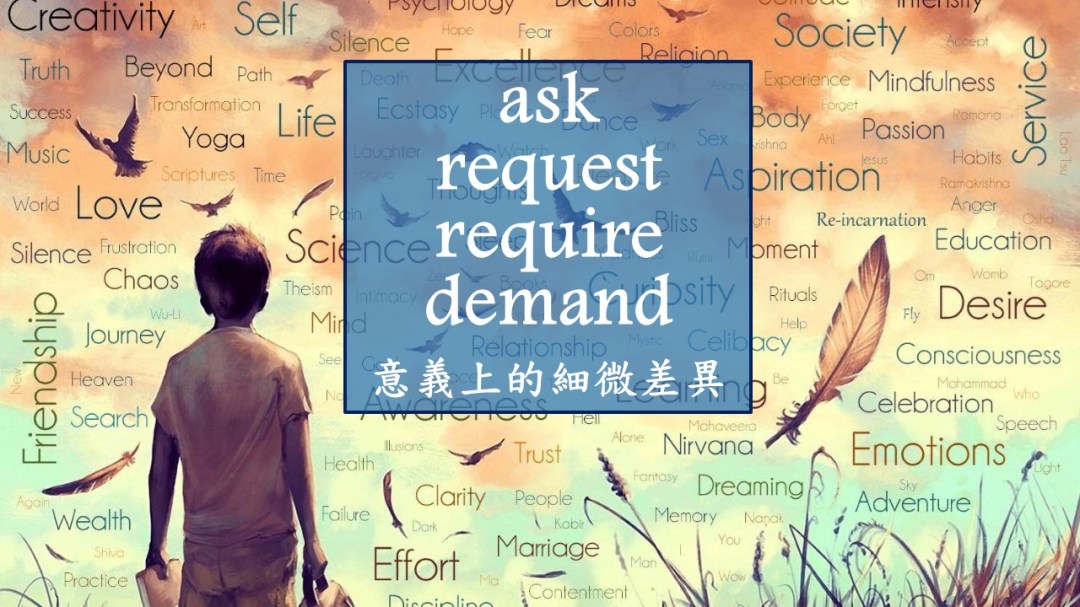
ask, request, require, demand都一樣嗎!

這四個動詞都有「要求、請求、需要」的意義,但內涵及用法並不相同。

  • ask最常見,初學者用ask表達「問問題」,例如May I ask a question? 所以ask是為了完成某事而口頭(或書面)提出請求,甚至有「拜託」的意思,例如:
    (1) I asked for help. (我請求協助)
    (2) I asked my classmates to help me. (我請求我的同學幫我)
    (3) Father asked that we stay at home at night. (爸爸要求我們晚上待在家。)

  • request通常是有權提出的(正式)請求,當有人對我們說It is my request. 代表那個人對我們提出有道理的要求。例句:
    (1) The villagers requested assistance. (那些村民請求幫助)
    (2) We requested the local government to return our land. (我們要求政府歸還土地)
    (3) They requested that the meeting be held next Friday. (他們要求會議下周五舉辦)

如果將句子改成They asked that the meeting beheld next Friday.意思上有請求或拜託的意思。

  • require是指根據法律、規定提出要求,意為「依照規定…」,常用在被動語氣。例句:
    (1) Students require more help in the first term. (學生在第一學期需要較多協助)
    (2) We had better do things that are required by law. (我們最好已依法完成一切)
    (3) The rules require that you bring one guest to the meeting. (按照規定,你要帶一位來賓出席會議)

  • demand是「(強烈)要求」的意思,所以常用We have a demanding teacher.來描述要求很多的老師。例句:
    (1) I demand my rights. (我要求應有權利)
    (2) The police demanded our name and address. (警方要求我們提供姓名住址)。
    (3) The library demanded that he return the books he borrowed in a week. (她要求他把從她那裡借走的書還回來。)

這四個動詞的受詞都可用that +名詞子句表達「急迫性語氣」,只是強度不同。

  1. The students asked that they (should) be allowed to use a calculator. (學生要求被允許用計算機)。句中的should可以省略,但動詞仍是原形be allowed。
  2. Teachers requested that the government halt the plan. (老師要求政府停止該計畫)
  3. The manager required that the machines work all night. (廠長要求機器整晚運作)
  4. The boss demanded that we finish the work in 2 days. (老板要求我們兩天內完成)

無論您是(1)注重口說寫作的國高中生; (2)提升競爭力的英文老師; (3)努力成為各科雙語老師; 或(4)提升專業英語說寫能力的碩博生或社會人士。請洽客製化訓練課程詢問專線

唯一雲端虛擬教室,將想法全文輸入輸出訓練🎯,雲端專人訂正提供改善建議。
影片線上教學平台:Youtube教學頻道
提升國際競爭力 加入超凡遠距 

A Ball of Ice Cream很OK!

嚇唬台灣人的下面這種貼文標題令人厭惡。

「不想被外國人笑,一球冰淇淋別說成a ball of ice cream…」https://www.businessweekly.com.tw/careers/blog/19212

然後文章作者就說”a scoop of ice cream”才是正確的表達。會這樣說的人其實並不懂文字的內涵,就好像有人台灣人說”drink soup”就GG了一樣,沒有思考用字的真正意義。下面這篇The New Yorker的文章第四行正好用到a ball of ice cream, https://www.newyorker.com/magazine/1939/03/11/department-of-amplification-5

有關食物的文章提到balls of ice cream很多。我們想想「一球冰淇淋」跟「一勺冰淇淋」是否有意義上的差異?如果是在路邊攤跟拿著勺子的小販說「兩勺冰淇淋」或「兩球冰淇淋」都沒甚麼問題的,但我們應該不會走進餐廳,在沒有看到勺子的情況下說:我要「兩勺冰淇淋」,這時我們當然說”two balls of ice cream”。

要說好語言不必自我設限,當我們對句子的結構非常熟練,再多體會文字的真義,我們用簡單的單字也能做深入的表達。

想要進行大量全文說寫輸出訓練嗎?想參與英語主題討論,歡迎了解全文輸入輸出訓練,並跟我們聯繫

作文標題單字大小寫

參加考試時如果有英文作文項目,如果應試者必須自訂標題或抄寫標題,常常會困惑於是否每個字的第一個字母都需要大寫,本文參考AP Stylebook,列出字首字母大小寫的通則,但是並不是所有出版商或作者都會按照這些論文規範,如果不想過於麻煩,那只要按照下面這句話即可:第一及最後一字的字首大寫,中間的字介係詞及連接詞不必大寫,其他字首都大寫

  • 寫作作品的標題與副標題必須首字母大寫
  • 標題中每個字原則上首字母需要大寫,但是to,以及冠詞a、an、the不需要大寫,除非這些字為標題的第一個字或最後一個字。
  • 除了冠詞之外,少於五個字母的介係詞及連接詞都不需要大寫,例如from、for、of、and、in不需要大寫,除非這些字為標題的第一個字或最後一個字,或是出現於副標題的句首或冒號後方。
  • 然而,如果不是冠詞、介係詞或連接詞,其他的詞類即使少於五個字母,每個單字的第一個字母都需要大寫。
  • 在文章中出現標題時,該標題的大小寫規則跟實際標題規則一樣,但通常以斜體字呈現。

標題舉例說明

The Success Against All Odds

A Diamond Is Forever

Forever Is a Diamond

Under the Dome Exists a Story to Grow

An End Is a New Life to Live For

We Live for a New Life

文章中出現標題舉例說明

Ernest Hemingway wrote For Whom the Bell Tolls.  

Girl on a Train is a thriller by A. J. Waines.

The Lion, the Witch and the Wardrobe is by C. S. Lewis.

17 感官動詞及使役動詞

感官動詞依語意可接Ving正在發生;V規律發生;PP…被動

see/ look at/ hear/ listen to/ feel/ smell/ observe/ watch/ notice

  1. I saw my friend running down the street. (表達當時正在進行的動作。)
  2. I saw my friend run down the street.
  3. When I wake up in the morning, I hear birds sing in the trees every day.
  4. John didn’t see the wallet taken by anyone.
    = John didn’t see anyone taking the wallet.
  5. May noticed her computer used by someone.

使役動詞有三個:make/ have/ get to

make, have, get to的主動語態。

  1. I made my brother carry my book bag. (我弟沒選擇,我要他幫我背書包。)
  2. I had my brother carry my book bag. (我弟幫我背書包,因為我要求他。)
  3. I got my brother to carry my book bag. (我成功地說服我弟幫我背書包。)

make, have, get to的被動語態。

  1. I had the mechanic repair the car. (主動)
    = I had the car repaired (by the mechanic.) (被動)
  2. Lee made her son clean his room. (主動)
    = Lee made his room cleaned (by her son.) (被動)
  3. May got her brother to do her homework. (主動)
    = May got her homework done (by her brother.) (被動)

    let, help: 後接動詞原形

    由於let與上方使役動詞make在中文都被翻譯成「讓…」,所以意義及使用上常造成錯誤。

    1. My father lets me drive his car.我爸讓我開他的車。 (這表示我很想開爸爸的車。)
    2. My brother helped me (to) wash my car.

    說明:let及help嚴格來說不算是使「役」動詞,反而是使「開心」動詞,但用法與使役動詞類似。

    大量英語全文說寫遠距訓練:全文輸入輸出訓練
    影片線上教學平台:Youtube教學頻道
    提升國際競爭力 加入超凡遠距

    16 表達時間的幾種方式

    表達時間有幾種不同的方式,英語人士最常使用的是第一項的直接表達,但學校的教學系統會比較重視其他稍為困難些的表達模式,考試也是以這些為主。

    (1) 直接表達:It is 12:10. (It is twelve-ten.)

    (2) 使用介係詞past (經過)或after (…之後):用於時間的分鐘在30分前。例句:

    It’s 07:10. = It’s ten past seven. = It’s ten after seven.

    (3) 使用介係詞to (到達)或before (…之前):用於30分鐘後。例句:

    It’s 06:50. = It’s ten to seven. = It’s ten before seven.

    (4) 使用名詞quarter (1/4 = 15分鐘):用於15分鐘或45分鐘。例句:

    It’s 09:15. = It’s a quarter after 9.
    It’s 09:45. = It’s a quarter to 10.

    (5) 使用名詞half (1/2 = 30分鐘):用於30分鐘。

    It’s 11:30. = It’s half past 11.
    It’s 11:30. = It’s half before 12.

    大量英語全文說寫遠距訓練:全文輸入輸出訓練
    影片線上教學平台:Youtube教學頻道
    提升國際競爭力 加入超凡遠距

    15 副詞子句

    副詞子句就是一個副詞加上一個句子,例如When I wake up, I wash my face first。這個句子中的When I wake up就是副詞子句,也就是S V O P A的句子結構下,A這個副詞能夠連接另外一個句子。也就是S V O P (A+SVOPA)。

    本單元僅以時間副詞子句為例子說明,可在39單元做更深入了解。

    表達時間關係的副詞子句

    by the time: 表達一事件發生時,另一事件已經發生。

    (a) By the time he arrived, we had already left.
    (b) By the time he comes, we will have already left.

    since/ever since: 表達自從或從那時到現在。

    (a) I haven’t seen him since he left this morning.
    = I haven’t seen him ever since he left this morning. (語氣較強烈)

    until/till: 表達某事持續發生直到另一事件發生。

    (a) We stayed there until we finished our work.

    as soon as/once: 表達"一旦"某事發生,另一事件即刻發生。

    (a) As soon as it stops raining, we will leave.
    = We will leave once it stops raining.

    as long as/so long as: 表達"只要"一條件成立,另一事件或條件也成立或發生。

    (a) I’ll never talk with him again as long as I live.
    = So long as I live, I’ll never talk with him again.

    whenever/every time: 表達”每當"一事件發生時,則另一事件也跟著發生。

    (a) Whenever she sees me, she says hello.
      = She says hello every time she sees me.

    the first time/the last time/the next time: 表達第一次、下一次、或最後一次某事件發生時,另一事件也會發生。

    (a) The first time (that) I went to New York, I went to a concert.
    (b) I saw two plays the last time I went to New York.
    (c) The next time I go to New York, I’m going to see a ballet.

    🎯將單字片語文法及想法運用於全文說寫輸出訓練,只有全文輸入輸出訓練,從大量全文的聽說讀寫訓練建立語感,唯一雲端虛擬教室,專人訂正作業提供改善建議。

    大量英語全文說寫遠距訓練:全文輸入輸出訓練
    影片線上教學平台:Youtube教學頻道
    提升國際競爭力 加入超凡遠距

    Give an example還是Make an example?差異頗大!

    「舉例說明」是我們在表達時常用到的措辭,但是如果不小心用錯動詞的話,我們傳達的意思就會跟我們心中的想法有差異,可能造成接收者的誤解。常用的有三種動詞:

    1. give an example準備舉實例說明
    2. set an example建立模範讓人模仿
    3. make an example訓誡某人以警告眾人

    例句:

    1. When you present your ideas, you had better give some specific examples.
      當你提出想法時,你最好舉出一些具體實例。
    2. You should set a good example to your children.
      你應該給自己的孩子做個好榜樣。
    3. The teacher made an example of the student who had copied his neighbor’s answers during the exam.
      老師以懲罰考試中抄襲鄰座答案的那位學生對其他人示警。

    而在談到舉出具體實例時,我們也有常用的表達方式:
    *take (某事物) for exampletake (某事物) as an example

    1. There are many problems with this system. Take the software as an example.
      這個系統有許多問題,例如軟體設備。
    2. People love Japanese cars. Take Toyota for example – in Taiwan, it sells the best.
      人們喜歡日本車,以Toyota為例,在台灣Toyota賣最好。
    3. Discussing is necessary. Take for example the discussion that was taking place in our last meeting. It generated valuable ideas.
      討論是必須的,以上次會議的討論為例,那次討論產生了重要的點子。
      (當要舉的例子很長,則可以將該例子放在for example後方。)

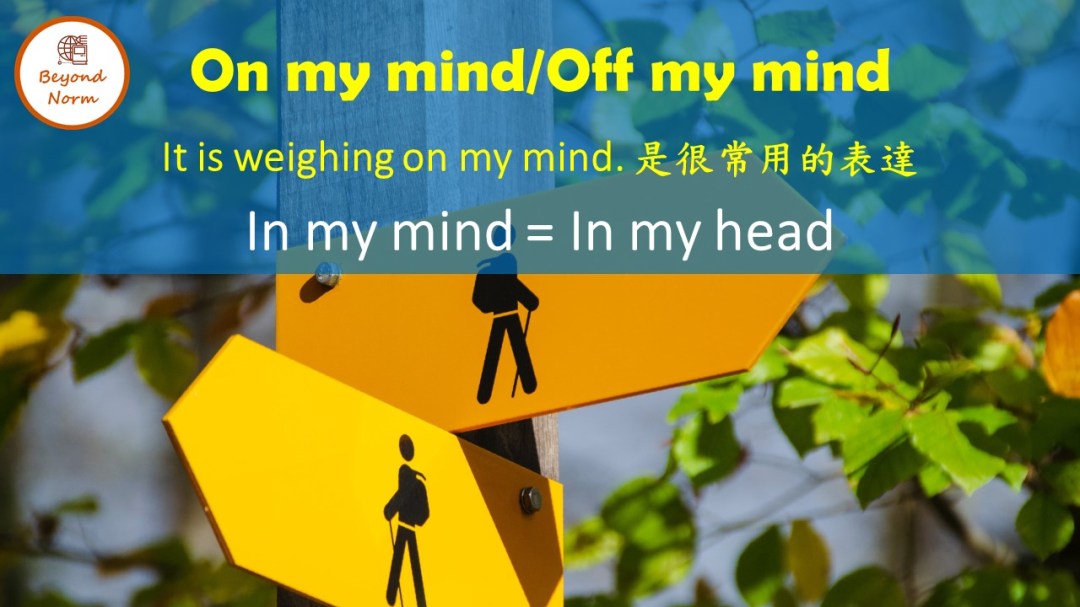
    29. on my mind/off my mind/in my mind

    on my mind掛念;在意/ off my mind放心/ in my mind心裡有想法

    當我們說There is something on my mind.這裡的on my mind意思是「考慮」或「掛念」某事,不盡然是壞事。若是要強調是令人憂慮的事情,可以加個動詞weigh (權衡輕重;加…重 ),It is weighing on my mind.或It is weighing on me.但是若是說成There is something in my mind.也沒甚麼錯誤,往往意思也能被體會,應該不至於有嚴重誤解現象發生。

    如果這個掛念已經不存在了或排除了,就可以說It is off my mind.這是很好的應用。

    然而in my mind則只是純粹心中有個想法,跟on my mind的差別有點像是中文「放在心中」跟「放在心上」的差別。in my mind意思跟in my head相同,更多人可能會說in my head,I have an idea in my head.或I have an idea in my mind.

    要真正提升英語能力必須要聽說讀寫並進,才能擴大背景知識,迅速掌握文意,超凡遠距全文輸入輸出訓練課程幫您同時提升英語聽說讀寫的能力。

    entrance, access, exit意思的異同

    entranceaccess 這兩個名詞單字都是「入口,通道」 的意思,例如:

    1. The entrance to the museum is on the other side of the building.
    2. The access to the museum is on the other side of the building.
      如果是指建築物的「入口」,這兩個字可互換。

    exit出口」是這兩個字的相反詞。

    The exit of the museum is on the other side of the building.

    如果是用動詞的話則是:

    1. You can enter the museum from the other side of the building.
    2. You can access the museum from the other side of the building.
      你能從建築物的另一頭進入博物館。
    3. You can exit the museum from the other side of the building.
      你能從建築物的另一頭走出博物館。

    但有幾點要注意:

    1. enter當動詞時後面不需要介係詞,例如I entered high school last year.許多人說成I entered into school last year. 這是錯誤的。

    2. access可用來表達「獲得某樣權利的許可」,這與entrance的意義不同:
    (1) The station has been upgraded with step-free access, which helps the disabled get entrance to the platforms.
    這裡的step-free access是指身障人士無需上下臺階的通道。

    (2) This is our VIP entrance. I’m afraid you do not have access to the lounge.
    這裡的access是指進入VIP包廂的許可。

    (3) After you pass the entrance, there is no Internet access in this building.
    這裡的Internet access是指供應網路的服務,也可以說Internet connection

    需要練習將單字片語應用於全文說寫?請進一步了解超凡遠距全文輸入輸出訓練

    because of/ due to/ owing to/ as a result of/ on account of/ thanks to在句子中可以互換嗎?

    由於duebecause詞類不同,所以在結構上是要注意修飾的是甚麼詞性。Due是形容詞,所以修飾名詞,because是副詞,所以修飾動詞或形容詞。

    例句1:表達「夏令營因為颱風而取消。」

    • The cancellation of the summer camp was due to the typhoon.
    • The summer camp was canceled because of the typhoon.

    第一句使用due to因為是修飾cancellation這個名詞。
    第二句使用because of因為是修飾was canceled這個動詞。

    例句2:表達「十字路口的重大車禍導致交通阻塞。」

    • The traffic jam was due to a terrible accident at the intersection.
    • The traffic jam happened because of a terrible accident at the intersection.

    但是愈來愈多英語使用者,其中不乏母語人士,將because of/ due to/ owing to/ as a result of/ on account of/ thanks to都交換使用,所以大家也就愈來愈不以為意。但是回答Why開頭的問題時還是要用because回答才正確。而thanks to除非是反諷的用意,否則最好用於正面的事情。

    例句3:表達「夏令營因為颱風而取消。」因此必須待在家讀書,用thanks to表達反諷的含意。

    • The summer camp was canceled because of the typhoon.
    • The summer camp was canceled thanks to the typhoon. Now we can only study at home.

    無論您是(1)注重口說寫作的國高中生; (2)提升競爭力的英文老師; (3)努力成為各科雙語老師; 或(4)提升專業英語說寫能力的碩博生或社會人士。請洽客製化訓練課程詢問專線

    唯一雲端虛擬教室,將想法全文輸入輸出訓練🎯,雲端專人訂正提供改善建議。
    影片線上教學平台:Youtube教學頻道
    提升國際競爭力 加入超凡遠距