drink soup很OK,不要僵化文字!

我常看到英語達人或網紅告訴我們某個表達是錯的,但真是如此嗎?我不只一次看到這些人說「喝湯不可以說drink soup,要不然就GG了!」或「 maybe只能放在句首 」或「修飾人時才用過去分詞當形容詞 」這類的言詞。這種沒有探討文字內涵,不斷以訛傳訛的說法不算少。建議大家一定要內化文字、建立語感,才具備靈活的全文說寫能力。

想像一碗雞湯,我們「喝」湯「吃」雞肉有何不對??? We drank the soup and ate the chicken.不是嗎? 或者一碗雞湯,當湯裡面的雞肉吃完了,我們當然只能 drink剩下的湯,或當裡面的湯喝完了,我們當然只能eat剩下的雞肉。

只是我們的文化把這整件事情說成「喝湯」,總不能說吃喝湯。英語人士說成”eat soup”,但是他們純喝湯仍然是”drink”、然後”eat”湯裡的雞肉。這兩個字的基本定義就是eat是指經由咀嚼將食物送進胃部,drink則是不需經過咀嚼,但基本定義是不可能涵蓋所有可能性的,只要文法正確,字的選擇代表的是講者或作者的想法,我們需要思考才能體會。

下方網頁中也有各地人士針對這個議題做探討: Do you eat or drink soup? It is now the cause of much debate around the office.

⭐文字在字典中的定義是狹義,不可能涵蓋所有可能性(廣義)!語言能力好是因為能廣義活用文字,讓受眾產生想像,觸動人們的內心世界,但關鍵在「使用」英語,也就是說寫輸出想法跟他人分享。台灣的確缺乏英語說寫環境,不像新加坡或吉隆坡,但是我們可以自己創造環境,超凡遠距的全文輸入輸出訓練就是能讓學習者大量全文說寫的訓練課程,訓練過程單純有效率,雖有挑戰,但保證有效果。

cloth/clothes/clothing/clothe常用但分不清!

雖然常分不清楚,但是因為不會誤解,所以多數人也就沒弄清楚。
要用好英語,最重的就是弄清楚詞類,及詞類在句子結構的位置。

  1. cloth名詞,布料的總稱,是不可數名詞。例如:
    We used a piece of cloth to cover the table. (我們用一塊布覆蓋桌子。)
  2. cloth名詞,抹布,是可數名詞,所以cloths是抹布的複數🙂。例如:
    I need a wet cloth to clean the table. (我需要一塊濕抹布擦桌子。)
  3. clothes名詞,衣服,跟jeans, pants, shorts一樣,都是以複數呈現。例如:
    Most people wear casual clothes, such as jeans or sportswear. (多數人穿休閒服,例如牛仔褲或運動服。)
  4. clothing名詞,衣服或服裝,多數情況下意思跟clothes類似。例如:
    Wear comfortable clothing to your PE class. (穿舒適衣服來上體育課。)
    但是有時候會加上單位an article of,例如:
    You can only take 3 articles of clothing into the changing room.
    (你一次只能帶三件衣服到試衣間。)
  5. clothe動詞,提供…衣服穿,例如:
    To feed and clothe a big family of 6 children cost a lot of money. (提供6個孩子的大家庭衣服食物要花很多錢。)
  6. clothes store服裝店,clothing factory成衣廠,是慣用的表達。

⭐友善提醒:你必須常做全文說寫練習,從錯誤中學習,以提升說寫表達能力。過度研究單字片語無法有效率提升說寫能力。

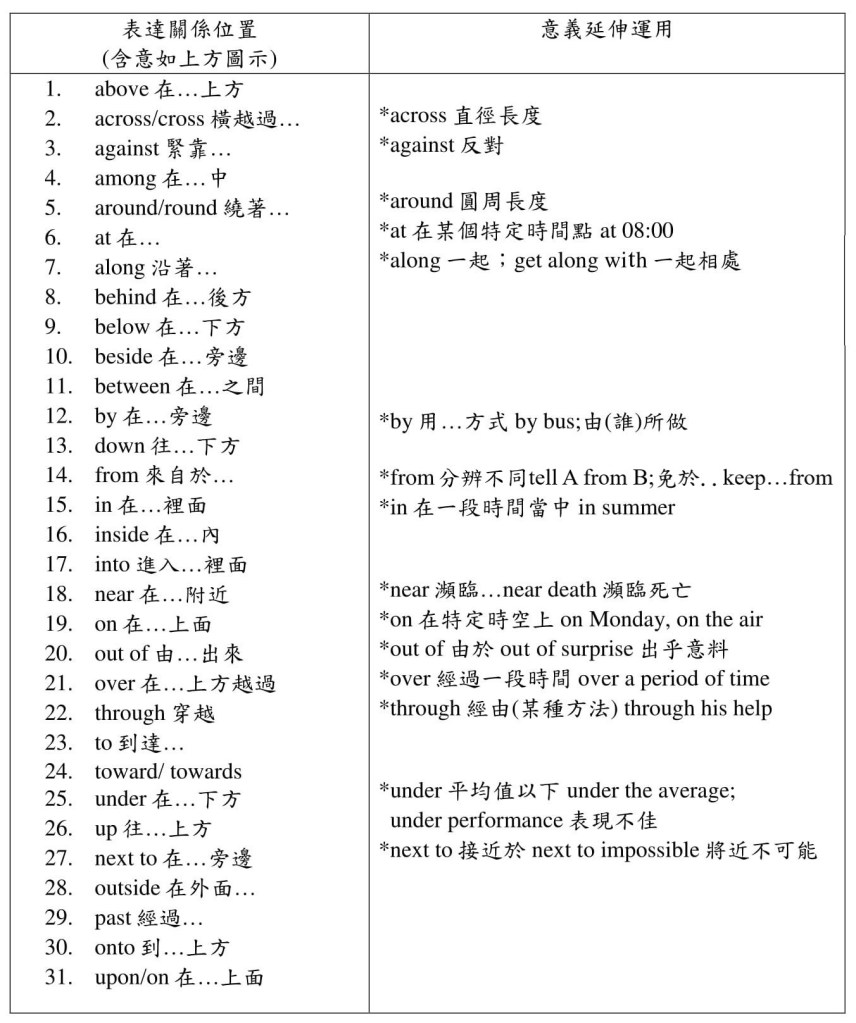
🎈如何靈活、正確運用介係詞

介係詞(前置詞)

由關係位置介係詞的基本含意而衍生出用於其他場合的廣義介係詞

自由正確運用介係詞的關鍵:

1. 熟悉句子結構,請參閱基礎句子結構的文法教學,或中級文法一次通

2. 了解本文所列的狹義含意,再體會廣義含意,然後與自己的表達靈活結合。

I. 最常見表達關係位置的介係詞:

II. 非表達關係位置的介係詞:

  1. besides此外
  2. beyond超越
  3. about大約;即將
  4. after在…之後
  5. as以…的身份;作為
  6. before在…之前
  7. during在…期間,例如during the vacation度假期間
  8. except除了…之外
  9. for為了;因為…
  10. of屬於…的一部分
  11. off離開,遠離
  12. with一起;有…
  13. like像…
  14. next下一個
  15. per平均每一…
  16. since自從
  17. than比…更…
  18. unlike不同於
  19. until直到…
  20. within不超過…期間
  21. without沒有一起
  22. despite儘管

III. 較少使用的介係詞或你可能不知道的介係詞

  1. aboard登上…(交通工具)
  2. beneath/ below在…下方
  3. underneath/ below在…下方
  4. amid/ in the middle of在…中間
  5. versus與…相比;以…為對手經由
  6. via經由(通常用於旅行中的行程)
  7. but/except除…外
  8. regarding/ about關於
  9. concerning/ about關於
  10. following緊接著…
  11. considering就…而言
  12. minus減(去)
  13. plus加,加上
  14. opposite與…相對;在…對面
  15. save: 意義同except; other than
    Everyone needs to know save Mary.除了Mary每個人都該知道。

注意事項

  1. 有些介係詞有其他的身分,這將使其用法與本文呈現方式不同,例如likecross都是動詞,但也是介係詞,只要熟悉句子的結構,自然能從句子中該字所在的位置做判斷,造句時注意結構。注意下列兩句話的變化:
    Tom ran across the street. (Tom跑步越過街道。)
    Tom crossed the street. (Tom越過街道。)
  2. 有些介係詞跟動詞結合運用,例如give upcross over…但是卻沒有名詞接在後方,例如I gave up! 這樣的介係詞是介於介係詞與副詞之間的運用,在文法結構中比較像是副詞的用法,但我們也可以說I gave up my plan.也就是純粹介係詞的用法。
  3. 少數介係詞是從動詞變成分詞候變化而來,例如:
    There will be a dance party following the dinner.
    此處的following意義等同於soon after,在字典中也被定義為介係詞,但也可以用不同的方式解讀:
    There will be a dance party (following the dinner).
    可以看成下方句子中的形容詞子句簡化成形容詞片語。
    There will be a dance party (that follows the dinner).
  4. as是最令人困擾的,
    as可以是意義如because的連接副詞:
    It’s not as good as it used to be.
    as也可以是意義如while一樣的連接副詞:
    As I was coming to school I saw Tom.
    as也可以是意義為in the same way「如同…一樣」的連接副詞:
    He entered Harvard just as his father had done years before.
    as也可以是意義為although的連接副詞:
    Angry as he was, he tried to keep calm.
    as當然也是介係詞:
    I see my old brother as a good friend.
    Tom works as a chef at the restaurant.

🎈本文或任何字典均難以涵蓋一個介係詞所有可能的含意,學習者必須從狹義含意延伸到廣義含意,體會可能涵蓋的意義範圍,如此才能靈活運用。決定介係詞的含意,必須從前後句子的語境理解做起。

I don’t have the Internet.我沒有網路?

I don’t have the Internet.雖然文法沒錯,但跟表達者所想的內容可能不同。

I don’t have the Internet.意思是「我沒有擁有整個網路。」這當然是事實,網路(WWW)或互聯網並不屬於任何人,但這並不是「我沒有網路可以上網」的意思。

若要表達「我沒有網路可以上網」,有下列幾種表達:

  1. I don’t have access to the Internet.
  2. I cannot access the Internet.
  3. I cannot connect to  the Internet.
  4. I have no connection to the Internet.
  5. We don’t have Internet connection here.
  6. There is no Internet access here.

現在越來越多人接受網路 the internet 這個字用小寫開頭 (除非是在句首),大家閱讀的時候可以多留意。。

7. Occur/ Happen/ Take Place 是否可以互換?

1. Occurhappen表達「發生」時,通常可以互換。
The sunset occurred at 6 p.m. = The sunset happened at 6 p.m.

2. happen也有「碰巧或偶然…」的意思,不能跟occur互換。
I happen to know him. 我碰巧認識他。
It happens that schoolchildren think it is Monday morning after a Sunday nap.
小學生星期天睡完午覺就以為是星期一早上了,這種事偶而會發生。

3. occur to可以表達「想到某件事或有了某個想法」,通常不能跟happen互換,但也有出現過it happened to me that… 這樣的表達。
It occurred to me that I was on the wrong side of the road.
我突然想起我走錯邊了。
What occurred to you? 你有甚麼想法?
⭐What happened to you? 你發生甚麼事?(兩句話意思不同。)
It happened to me that I walked on the wrong side of the road when I was abroad.
當我出國時,走路走錯邊的事發生過。

4. Take place是在某個時間地點「舉辦」某事,通常是指預先計畫好的事件,這可從take place (佔據一個地方)這兩個字的含意感受出來,既然是計畫好的事就極少用於像是地震這樣的不預期事件,但仍然有人會說The earthquake took place。
The wedding took place on Sunday afternoon. 婚禮在星期天下午舉辦。

學到了還要用到才算學會,超凡遠距全文輸入輸出訓練讓你學到用到。

39 副詞子句與四種連接詞

連接詞在句子中非常重要,負責將兩個想法做邏輯連接。在句子中的運用有四種不同的方式:注意位置及標點符號。

  • 副詞子句:用以連接兩個子句。
    Because he studies very hard, he is able to pass every exam.
  • 介係詞片語:記得後面只能夠用名詞。
    Because of studying hard, he is able to pass every exam.
  • 純連接詞:在句子中間當橋樑。
    He studies very hard, so he is able to pass every exam.
  • 轉折詞:在一個單獨的句子中。
    He studies very hard. Therefore, he is able to pass every exam.

常見的錯誤

  • Because I was busy, so I didn’t go shopping.
  • Because of I was busy, I didn’t go shopping.
  • I was busy, therefore, I didn’t go shopping.
  • Because I was busy. I didn’t go shopping.

下列句子均表達同樣意義,注意其不同用法及標點符號。

  1. 副詞子句
    Because he studies very hard, he is able to pass every exam.
    = He is able to pass every exam because he studies very hard.
    = Since he studies very hard, he is able to pass every exam.
    = He is able to pass every exam since he studies very hard.
  2. 介系詞片語
    Because of studying hard, he is able to pass every exam.
    = He is able to pass every exam because of studying hard.
    = Due to studying hard, he is able to pass every exam.
    = Owing to studying hard, he is able to pass every exam.
  3. 移轉詞
    He studies very hard. Therefore, he is able to pass every exam.
    = He studies very hard. He, therefore, is able to pass every exam.
    = He studies very hard. He is able to pass every exam, therefore.
    = He studies very hard; therefore, he is able to pass every exam.
  4. 純連接詞
    He studies very hard, so he is able to pass every exam.
    = He is able to pass every exam, for he studies very hard.

  17 連接詞圖表 2例句:以下列兩個想法運用不同連接詞表達。
(1) study hardnot study hard
(2) pass the examfail the exam.

  1. Because I did not study, I failed the exam.
  2. Although I studied, I failed the exam.
  3. I did not study. Therefore, I failed the exam.
  4. I did not study. However, I passed the exam.
  5. I studied. Nevertheless, I failed the exam.
  6. Even though I did not study, I passed the exam.
  7. I did not study, so I failed the exam.
  8. Since I did not study, I failed the exam.
  9. If I study for the test, I will pass the test.
  10. If I studied for the test, I would pass the test.
  11. If I had studied for the test, I would have passed the test.
  12. Unless I study for the test, I will not pass the exam.
  13. I must study; otherwise, I will not pass the exam.
  14. Even if I study, I won’t pass the exam.
  15. I did not study; consequently I failed the exam.
  16. I did not study; nonetheless I passed the exam.
  17. I will probably fail the test whether I study or not.
  18. I failed the exam, for I didn’t study.
  19. I have to study so that I will pass the exam.
  20. Only if I study, I will pass the exam.
  21. I studied hard, yet I (still) failed the exam.
  22. You’d better study, or (else) you will fail the exam

唯一雲端虛擬教室,將想法全文輸入輸出訓練🎯,雲端專人訂正提供改善建議。
影片線上教學平台:Youtube教學頻道
提升國際競爭力 加入超凡遠距

無論您是(1)注重口說寫作的國高中生; (2)提升競爭力的英文老師; (3)努力成為各科雙語老師; 或(4)提升專業英語說寫能力的碩博生或社會人士。請洽客製化訓練課程詢問專線

23 比較級及最高級

比較級用於比較兩樣事物的好壞及其他特質的高低,例如A比B高:
A is taller than B.
tall這個形容詞必須做適當的拼字變化,規則如下:

最高級用於陳述某樣事物是最好的或是最壞的,例如A是全班最高的:
A is the tallest in the class.
tall這個形容詞必須做適當的拼字變化,規則如下:

將單字片語文法及想法運用於全文說寫輸出訓練,請參考全文輸入輸出訓練,從大量全文的聽說讀寫訓練建立語感,唯一雲端虛擬教室,專人訂正作業提供改善建議。

超凡遠距全文輸入輸出訓練,效率效果又經濟。無論您是(1)注重口說寫作的國高中生及(2)提升競爭力的英文老師(3)還有努力成為雙語教室的各科老師(4)以及要提升專業英語說寫能力的碩博生。都能找到客製化訓練課程!請洽詢問專線

38 分詞形容詞

分詞形容詞的基本概念是每個動詞都可以變成兩個形容詞,(1) V-ing;(2) V-en。

因為每個動詞有4個型,例如do/ did/ doing/ done (原型/過去式/現在分詞/過去分詞),doing及done這兩個分詞可以當作形容詞,現在分詞V-ing為主動涵義形容詞, 過去分詞V-en為被動涵義形容詞。

如何判斷用哪一個呢?我們以bore (使…厭煩)為例,先造一個句子,如果對句子形成的概念不夠清楚,請參考句子基本結構

The class bores me. 動詞bore 形成兩個形容詞如下:

  1. The class is boring. (用動詞bore當形容詞修飾主詞the class,是主動含意用boring。)
  2. I am bored. (用動詞bore當形容詞修飾受詞 me,是被動含意用bored。)

The problem confuses the students. 動詞confuse 形成兩個形容詞如下:

  1. The problem is confusing. 修飾主詞的是主動含意形容詞V-ing
  2. The students are confused. 修飾動詞的是被動含意形容詞V-en

Paul is exaggerating his experiences. 動詞exaggerate 形成兩個形容詞如下:

  1. Paul is exaggerating. (Paul很誇張。)
  2. His experiences are exaggerated. (Paul的經驗被誇大了。)

現在我們下面的句子幫助大家了解所有句子的變化:

A. The book interested Mary yesterday.
🎈interested是主動的過去式動詞。

B. Mary was interested by the book yesterday.
🎈was interested是被動動詞,介係詞by連接執行動詞動作的the book。

C. The book is interesting to Mary.
🎈interesting是主動含意的分詞形容詞。

Mary is interested in the book.
🎈interested是被動含意的形容詞,介係詞in連接形容詞感興趣的對象the book。

🎯將單字片語文法及想法運用於全文說寫輸出訓練,請參考全文輸入輸出訓練,從大量全文的聽說讀寫訓練建立語感,唯一雲端虛擬教室,專人訂正作業提供改善建議。

大量英語全文說寫遠距訓練:全文輸入輸出訓練
影片線上教學平台:Youtube教學頻道
提升國際競爭力 加入超凡遠距

無論您是(1)注重口說寫作的國高中生; (2)提升競爭力的英文老師; (3)努力成為各科雙語老師; 或(4)提升專業英語說寫能力的碩博生或社會人士。請洽客製化訓練課程詢問專線

英文法結構一次全通

🎁學習文法是為了造正確的句子,大量造句才能熟練運用文法,超凡遠距全文輸入輸出訓練讓您大量造句提升寫作及口說能力。

一次了解所有英文文法形成。🎯初級以上學習者可以從04:35的子句看起。

🎯文法是在一貫的概念下形成,所以一次學習有助於理解整體架構,分開學習較無效率及效果。閱讀本文時可點擊有滑鼠符號🖱文法項目深入學習。
文法就是將組成句子的元素,按照詞類正確擺在適當位置。

首先了解形成句子結構的詞類元素:

句子結構:S主詞 + V動詞 + O受詞 + (Prep+O)(介係詞+受詞) + ADV副詞.
詞類元素:N名詞 + V動詞 + N名詞 + (Prep.+N)介係詞+名詞 + ADV副詞.

例如:Tom practices English with Tina every day. 就是有五個元素的句子。

現在我們已經知道句子的結構中有三個位置會出現名詞:主詞/受詞/介系詞片語

以下為如何將想法形成名詞以正確方式擺放在名詞位置的文法項目。

(1)🖱人稱代名詞 I/ me/ mine/ myself 都是名詞,稱為主格/受格/所有格代名詞/反身代名詞。

I like you. You like me. I like my friend. My friend likes me.
I like myself. They like themselves.

(2)🖱動名詞V-ing:doing,把動作當作名詞使用,這時的V-ing通常表達習慣做的事。

Being a teacher makes me happy. I enjoy teaching people.

(3) 🖱不定詞to V: to do,把動作當作名詞要使用。這時的to V通常表達要去做的事。

I want to play basketball. To play basketball is OK with me.

(4) 🖱名詞子句:句子裡面的句子稱為子句,當作名詞用就稱為名詞子句。

I don’t know who the man is.
No one knows where the ship went. Where the ship went is a mystery.

例句中的where the ship went分別是句子的主詞及受詞。名詞子句可以是when, where, who…或whether開頭的名詞。

(5) 🖱假主詞:It可以代替整個名詞呈現的想法,稱為假主詞假受詞

It is important that everyone comes to class on time.
假主詞 It = 真主詞 That everyone comes to class on time is important.

We find it hard to climb the mountain.
假受詞 it = 真受詞 to climb the mountain

(6) 🖱同位語:用名詞子句來代替一個事實或說法,同位語也可以是名詞或名詞片語。

It is a fact that the Earth moves around the Sun. 地球繞著太陽轉是一個事實。
也就是fact與子句the Earth moves around the Sun意義相同

(7) 🖱分詞形容詞:名詞往往需要形容詞修飾,形容詞常出現在名詞前方。分詞形容詞概念就是,每個動詞都有兩個分詞型V-ing及V-en,這兩個型可以變成兩個形容詞。。

The book bores me a lot. 動詞bore可以加以運用變成形容詞:boring及bored。

The book is boring. 主動含意形容詞V-ing用以修飾主詞。
I am bored. 被動含意形容詞V-en用以修飾受詞。

(8) 🖱形容詞子句1/🖱形容詞子句2:用句子當作形容詞就是形容詞子句,形容詞子句的位置是在所修飾的名詞後方,一般形容詞的位置是在所修飾的名詞的前方。

We thanked the girl who showed us the way to the park.
我們感謝那位告訴我們去公園的路的女孩。

We are talking about the movie that we went to last night.
我們正在討論我們昨晚去看的電影。

(9)🖱形容詞片語:形容詞子句常簡化成形容詞片語,形容詞子句的簡化或分詞化。

We thanked the girl who showed us the way to the park.
= We thanked the girl showing us the way to the park.

Jean owns a house which has beautiful ocean views.
= Jean owns a house having beautiful ocean views.

句子結構中有一個位置會出現動詞,另外所有子句中也會有動詞。
動詞位置:S + V + O + (Prep. + O) + Adv.

🎁如何將動詞正確的擺放在下列動詞位置?

(1) 🖱時態變化(簡單及進行) / 🖱時態變化 (完成):形成動詞最重要的文法就是動詞時態變化。。每個動詞有四個形,do/did/doing/done,依表達涵義可能會出現12種變化。以做家事為例:

三個簡單式
…do housework every day (每天做)
…did … (昨天做)
…will do … (明天將會做)

三個進行式
…is doing … (正在做)
…was doing … (當時正在做)
…will be doing … (將會正在做)

三個完成式
…have done … (已經做)
…had done … (那時之前已經做)
…will have done … (將已經做)

三個完成進行式
…have been doing for 1 hour… (已經做一小時)
…had been doing for 1 hour … (那時就已經做一小時)
…will have been doing for 1 hour … (將已經做一小時)

(2) 🖱被動語態 (be + V-en):當主詞沒有表現動詞的動作即為被動語氣。

被動:Housework was done by me yesterday.
主動:I did housework yesterday.

The temple was built 100 years ago. (被動多用於不知道何者為動作執行者)

(3) 🖱一般情緒助動詞:這類助動詞的含意會因時間表達不同而有微妙轉變。例如:「我應該多運動」及「我那時候應該多運動」,雖然都是「應該」,但含意不同。「我那時候應該多運動」這句話則多了「該做卻沒有做」的情緒。

I should do more exercise. 我該多運動。(用於表達現在及未來)
Amy could be sick. She is running in rain now. Amy可能會生病,她現在在雨中跑步。

(4) 🖱 情緒助動詞表達過去事件:(could/must/should…)+ have + pp。

Amy could have been sick yesterday. She didn’t come to office.
Amy昨天可能是生病了,她沒來上班。

I should have done more exercise last year. (用於表達過去)
我去年該多運動(但是我沒有)。

(5) 🖱假設語氣 (跟現在事實相反):由於不是發生的事實,所以動詞使用特殊時態來表示跟事實不同。

I wish I were a fish. If I were a fish, I could go anywhere freely.
(事實是I am not a fish. I cannot go anywhere freely.)

I wish I didn’t have a job. If I didn’t have a job, I would feel happy.
(事實是I have a job. I don’t feel happy.)

(6) 🖱假設語氣 (跟過去事實相反):跟前方假設語氣 (跟現在事實相反)動詞變化不同。

I wish I hadn’t wasted time playing video games.
(事實是I wasted time playing video games.)

If I hadn’t wasted a lot of time, I could have entered NTU.
(事實是I wasted a lot of time. I didn’t enter NTU.)

(7) 🖱倒裝句:否定副詞擺在句首加強語氣,要像否定句一樣使用助動詞。

Never do I study at the library. 像否定句一樣要使用助動詞。
= I never study at the library.

Little does Amy know about sports.
= Amy knows little about sports.

(8) 🖱急迫性語氣:使用ask, insist, suggest, demand…等有急迫要求語氣的動詞時,表達求助的內容的句子中的動詞不必賦予時態。

I insisted that my brother not use my cellphone.

Jane’s father asked that Jane go mountain climbing with a guide.

句子結構中有一個位置會出副詞,另外所有子句中也會有副詞。
副詞位置:S + V + O + (Prep. + O) + Adv.

🎁如何將副詞正確的擺放在副詞位置?

(1) 副詞:副詞修飾動作發生的時間、程度,通常為形容詞+ly,例如easily,但部分例外,例如well、fast…。

May is a careful driver. She drives carefully.

Jane is a fast runner. She runs fast.

(2) 副詞子句:除了修飾動詞的副詞之外,也有連接句子的連接詞,例如because、when、if…

He always does well on exams because he studies very hard. 副詞子句也可以放在句子前方。

(3) 🖱分詞構句:或稱為副詞片語,將副詞子句簡化成副詞片語,其簡化的方式與形容詞片語相同。

Studying hard, Tim finally entered his dream university.
= Because Tim studied hard, he finally entered his dream university.

If invited, I will attend the meeting.
= If I am invited, I will attend the meeting.

無論您是(1)注重口說寫作的國高中生; (2)提升競爭力的英文老師; (3)努力成為各科雙語老師; 或(4)提升專業英語說寫能力的碩博生或社會人士。請洽客製化訓練課程詢問專線

唯一雲端虛擬教室,將想法全文輸入輸出訓練🎯,雲端專人訂正提供改善建議。
影片線上教學平台:Youtube教學頻道
提升國際競爭力 加入超凡遠距 。

48 分詞構句

可看影片或下方文字描述了解分詞構句

I. 將表達時間的副詞子句簡化成副詞片語:簡化方式為省略主詞留下動詞的分詞。

  1. 副詞子句與主要子句的主詞相同時,副詞子句可簡化為副詞片語。
    a. While I was sitting in class, I felt asleep.
    = While sitting in class, I fell asleep.
    b. Before I left for work, I ate breakfast.
    = Before leaving for work, I ate breakfast.
  2. 將時間副詞子句簡化成副詞片語。
    a. Since Maria came to this country, she has made many friends.
    = Since coming to this country, Maria has made many friends.
    b. After Peter (had) finished his homework, he went to bed.
        = After finishing his homework, Peter went to bed.
        = After having finished his homework, Peter went to bed.
  3. More about “While"
    a. While I was walking down the street, I ran into an old friend.
        = While walking down the street, I ran into an old friend.
        = Walking down the street, I ran into an old friend.
  4. About “When"
    a. When I reached the age of 20, I started to understand the meaning of life.
    =
    Upon reaching the age of 20, I started to understand the meaning of life.
        = On reaching the age of 20, I started to understand the meaning of life.

II. 將表達因果的副詞子句簡化成副詞片語

  1. Because Sue didn’t need money, she didn’t take the part-time job.
    = Not needing money. Sue didn’t take the part-time job.
  2. Because I have seen the movie, I don’t’ want to go again.
    = Having seen the movie, I don’t’ want to go again.
  3. Because she was unable to afford a car, she bought a bicycle.
    = (Being) Unable to afford a car, she bout a bicycle.
    *也可以簡化後只留下形容詞。

III. 連接詞and, then連接的表達也常以分詞構句的方式出現。

  1. She got into the room, sat on the ground, and began to cry.
    = She got into the room, sitting on the ground, beginning to cry.
  2. Many people eat at roadside stands, then they watch people passing by.
    = Many people eat at roadside stands, watching people passing by.
  3. Mary entered, and she was followed by Tom.
    = Mary entered, followed by Tom.
    *分詞構句可能留下現在分詞或過去分詞。

IV. 當兩個子句有不同的主詞時,所形成的分詞構句應包含主詞,以免誤解。

  1. As the sun had set, we started for home.
    = The sun having set, we started for home.
  2. Because the dog was running in front of me, I had to stop my car suddenly.
    = The dog running in front of me, I had to stop my car suddenly.
*分詞構句讓表達具有動感,讓聽眾或讀者更融入表達的情緒中!

唯一雲端虛擬教室,將想法全文輸入輸出訓練🎯,雲端專人訂正提供改善建議。
影片線上教學平台:Youtube教學頻道
提升國際競爭力 加入超凡遠距 。

無論您是(1)注重口說寫作的國高中生; (2)提升競爭力的英文老師; (3)努力成為各科雙語老師; 或(4)提升專業英語說寫能力的碩博生或社會人士。請洽客製化訓練課程詢問專線